

AZTERLAN’s Head of Sustainability and Environment, Lucía Unamunzaga, presented the main keys of the LIFE REAMINE project and took part in the round table “How to prepare a LIFE proposal? Key aspects”, held within the framework of the Information Day – INFODAY LIFE Spain 2026.
Organised by the Spanish Ministry for Ecological Transition and the Demographic Challenge, INFODAY LIFE Spain 2026 brought together institutional representatives, European experts and leading organisations in sustainability and environmental innovation in Madrid on 7 May to present the latest developments in the LIFE 2026 calls and share practical experiences related to the preparation and management of European projects.
Representing AZTERLAN, Lucía Unamunzaga, Head of Sustainability and Environment, took part in the session dedicated to the key aspects for preparing competitive proposals, using the experience gained in the LIFE REAMINE project as a practical case study. During her presentation, in addition to providing details about the project currently underway and its definition process, the researcher highlighted the importance of clearly identifying the impact pursued by the project from the very early preparation stages, pointing to this as one of the determining factors for successfully building a LIFE proposal, together with the proper identification of the project KPIs.
Following her presentation, Lucía also participated in a round table together with representatives from organisations such as Fundación Global Nature, Tecnalia and Intergia Energía Sostenible, where recommendations, lessons learned and best practices to improve the quality and feasibility of future European proposals were discussed.
AZTERLAN has a solid track record within the LIFE programme, having developed several European projects linked to the circular economy, resource efficiency and industrial sustainability, including LIFE REAMINE (currently ongoing) and the completed projects LIFE Green Casting, LIFE HI4S and LIFE ECO-SANDFILL.
INFODAY LIFE Spain 2026 featured the participation of representatives from the Spanish Ministry for Ecological Transition and the Demographic Challenge, IDAE and the European Climate, Infrastructure and Environment Executive Agency (CINEA), who shared the main updates regarding the LIFE 2026 calls and provided guidance to organisations interested in participating in the programme. The LIFE Programme is the European Union’s main financial instrument for the development of projects related to the environment, climate action and the energy transition. Since its creation in 1992, it has supported thousands of innovative initiatives across Europe aimed at promoting a more sustainable and decarbonised economy.
▶️ Watch Lucía’s participation
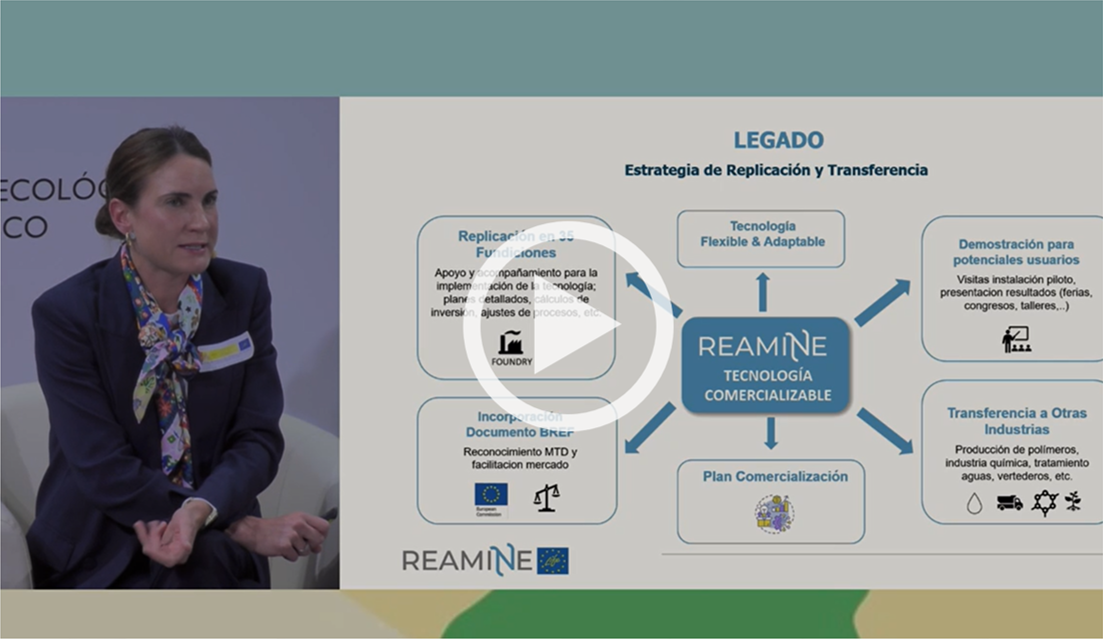
Lucía Unamunzaga at INFODAY LIFE España 2026.