Thermal Analysis in Iron Casting: From Metallurgical Understanding to Advanced Process Control

Thermal analysis has become one of the most effective and widely adopted tools for process control in iron foundries. By analysing the solidification and cooling behaviour of molten metal, foundries can obtain valuable information about chemical composition, metallurgical quality, nodularity, feeding behaviour and final material performance.

AZTERLAN has contributed a consecutive series of technical articles to the Foundry Trade Journal (FTJ), a specialist publication dedicated to the foundry industry, its technologies and manufacturing processes. Across the series, AZTERLAN explores the principles, industrial applications and advanced process control opportunities enabled by thermal analysis.

Together, these publications provide a comprehensive overview of how thermal analysis can help foundries improve quality, increase casting yield, reduce costs and move towards more predictive and data-driven manufacturing strategies.

Authors:

Beñat Bravo (AZTERLAN), Iker Asenjo (AZTERLAN), Ander Areitioaurtena (AZTERLAN)

Related contents:

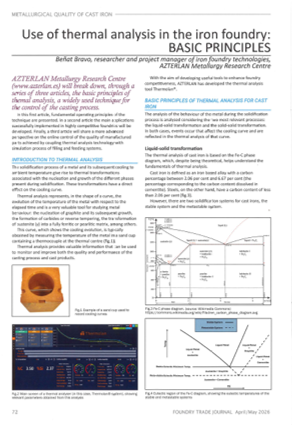
1.- Use of Thermal Analysis in the Iron Foundry: Basic Principles

The first article introduces the scientific foundations of thermal analysis and explains how cooling curves can be used to characterise cast iron during solidification and solid-state transformations. It describes the relationship between thermal events and key metallurgical parameters.

The article also demonstrates how thermal analysis enables foundries to move beyond traditional chemical control by extracting additional information from the solidification process itself. Particular attention is given to the interpretation of liquidus and eutectic temperatures, the influence of alloying elements and the prediction of microstructural characteristics from thermal data.

Key topics covered:

  • Thermal analysis fundamentals and cooling curve interpretation.
  • Determination of carbon equivalent and silicon content.
  • Stable and metastable solidification systems.
  • Influence of alloying elements on solidification behaviour.
  • Prediction of final matrix structure through eutectoid transformation analysis.
Beñat Bravo
Beñat Bravo

Iron Foundry Technologies

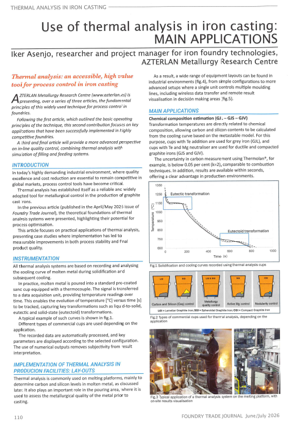
2.- Use of Thermal Analysis in Iron Casting: Main Applications

The second article focuses on the practical implementation of thermal analysis in productive processes and presents real industrial applications demonstrating its value for metallurgical control. It explains how thermal analysis systems can be integrated into melting and pouring operations to provide rapid, objective and actionable information for process management.

Industrial case studies illustrate how thermal analysis can be used to control active magnesium levels, monitor nodularity, assess metallurgical quality and optimise inoculation practices. The reported results show significant improvements in process stability and substantial reductions in consumable usage and production costs.

The article also highlights the increasing integration of thermal analysis data with intelligent manufacturing systems, creating new opportunities for predictive process control and defect prevention.

Key topics covered:

  • Carbon and silicon estimation.
  • Active magnesium control in ductile iron.
  • Nodularity control in compacted graphite iron.
  • Metallurgical quality assessment prior to pouring.
  • Industrial case studies demonstrating cost savings and process optimisation.
  • Integration with intelligent process management systems.
Iker Asenjo
Iker Asenjo

Iron Foundry Technologies

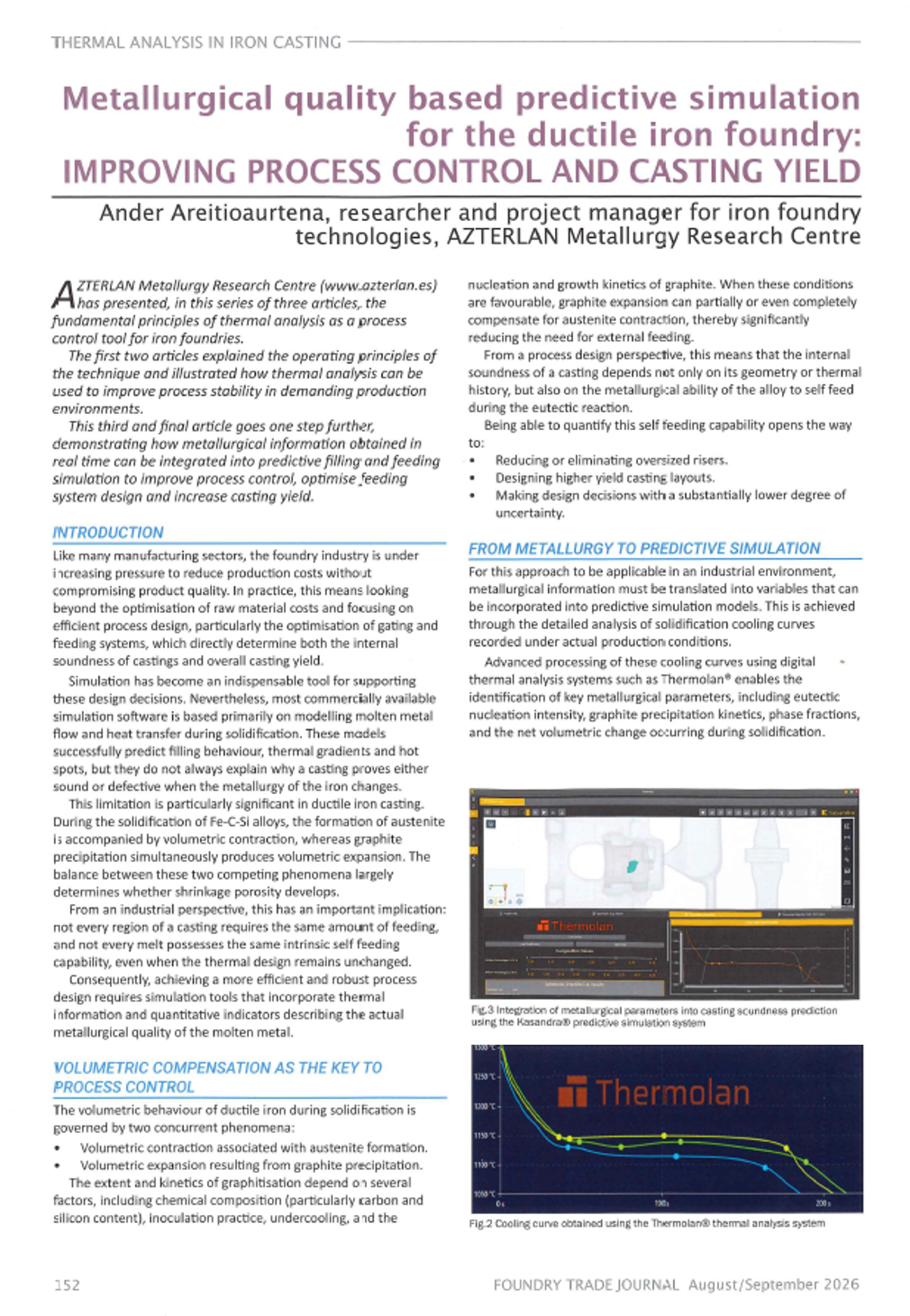
3.- Metallurgical Quality-Based Predictive Simulation for the Ductile Iron Foundry: Improving Process Control and Casting Yield

The third article presents an advanced approach that combines thermal analysis with predictive simulation tools, integrating metallurgical quality parameters directly into casting simulation models. The methodology enables foundries to quantify the self-feeding capacity of ductile iron and improve the prediction of shrinkage formation and casting soundness.

A featured case study demonstrates how thermal-metallurgical analysis made it possible to replace a conventional two-riser feeding design with a single riser while maintaining casting integrity. Validation through computed tomography and metallographic analysis confirmed the accuracy of the predictions and highlighted the potential for significant yield improvements.

The article proposes a new design philosophy in which metallurgy becomes an active input to predictive simulation rather than a background assumption, enabling more reliable decisions and more efficient feeding system designs.

Key topics covered:

  • Integration of metallurgical quality into casting simulation.
  • Prediction of self-feeding capacity and shrinkage behaviour.
  • Optimisation of feeding systems and riser design.
  • Industrial validation using computed tomography and metallography.
  • Improved casting yield, process reliability and manufacturing efficiency.
Ander Areitioaurtena

Intelligent Manufacturing Technologies

Back

Contact with Beñat.

Contact Iker

Contact Ander.

How can we help you?.

Keep up with AZTERLAN’s activity.

Fill out this form to download this resource

Request demo

Fill out this form to receive access to demo contents of the course in your email. 

Contact Gorka

Get in touch with Andoni

Contacta con Ramón

Contacta con Xabier

Contact with Maider Muro

Contact with Dr. Urko de la Torre

Contact with Dra. Anna Regordosa

Contact with Aitor Loizaga

Contact with Dr. Rodolfo González-Martínez

Contact with David Aristondo.

Contact with Juan J. Bravo.

Contact with David Garcia.

Contact with Jose Ramon.

Contact with Oihana.

Keep up with AZTERLAN’s activity.

Contact with David.

Contact with Ibon.

Contact with Hegoi.

Contact with Itziar.

Contact with Erika.

Contact with John.

Contact José Javier.