
The CAESAR European project has validated new strategies to upgrade post-consumer ferrous scrap, incorporate it into flat steel production and recover high-purity recycled copper from the scrap cleaning process, while simultaneously reducing the overall environmental impact of steelmaking.
Every year, Europe generates millions of tonnes of steel scrap, much of it originating from end-of-life vehicles, household appliances, electronic waste and structures that have reached the end of their service life. Although these materials have significant recycling potential, the presence of residual elements such as copper (a valuable metal) limits their use in the production of high-performance steels. As a result, a substantial share of this scrap is exported outside the European Union, while the European steel industry continues to rely on virgin raw materials and medium- to high-quality scrap.
After four years of research, the European project CAESAR (CirculArity Enhancements by Low-quality Scrap Analysis and Refinement) has demonstrated that scrap with high levels of residuals and contaminants can be successfully reused in higher value-added applications. The consortium, bringing together recycling companies, research centres, universities and steel producers from several European countries, has developed multiple research lines aimed at improving the characterisation, sorting and upgrading of low-quality scrap, validating its industrial use, recovering high-value materials from cleaning rejects and assessing the environmental benefits of these new strategies.
Industrial validation for manufacturing flat steel products using upgraded high-residual scrap
One of the project’s main research lines was carried out jointly by ArcelorMittal Sestao, Reydesa Recycling and AZTERLAN Metallurgy Research Centre, demonstrating the industrial feasibility of incorporating upgraded post-consumer scrap into the production of steel coils in an electric arc furnace.
As explained by AZTERLAN sustainability and environmental researcher Clara Delgado: “Increasing the amount of scrap that can be reintroduced into the steelmaking process without compromising steel quality is one of the major challenges facing the European steel industry. Within CAESAR, we have demonstrated that a significant proportion of high-residual scrap, which is currently used mainly for long-product manufacturing in electric arc furnaces, can become a competitive alternative to the high-quality scrap grades that are becoming increasingly scarce on the market for the production of low-carbon steel coils, both through the integrated route and the electric arc furnace route. This has been achieved through the appropriate combination of advanced sorting and cleaning technologies.”
Following successful validation at pilot scale in AZTERLAN’s Foundry Pilot Plant, the team carried out several industrial heats at the ArcelorMittal Sestao steel plant using charge mixes containing between 10% and 20% upgraded E1 demolition scrap processed using technologies developed by Reydesa Recycling. The results confirmed that this scrap can be used to manufacture flat steel products without affecting either the metallurgical quality of the steel or the performance of the steelmaking process.
“Not only have we confirmed that steel quality is maintained, but we have also demonstrated that this type of scrap can be integrated into real industrial production without introducing additional complexity into steelmaking operations. This aspect, together with the economic viability of the process, is essential for these solutions to be widely adopted across the steel industry,” highlights Clara Delgado.
Lower environmental impact and recovery of high-purity copper
CAESAR also assessed the environmental impact of this new approach through a Life Cycle Assessment (LCA), considering both the upgrading of the scrap and its subsequent use in steel production.
The results show that incorporating 13% upgraded scrap reduces the overall environmental footprint of electric arc furnace steel production by 12.6% and lowers greenhouse gas emissions by 8.1% compared with a conventional scrap mix. Although the upgrading operations require additional energy consumption, this is significantly lower than that associated with producing iron ore-based raw materials and is more than offset during the steelmaking process. Keeping these scrap streams within the European value chain also avoids exports and the emissions associated with international transport.
Another important achievement of the project has been demonstrating that the non-ferrous metals and alloys contained in steel scrap should no longer be regarded merely as impurities by steelmakers, but rather as valuable strategic resources. During the project, copper concentrates with a purity exceeding 99% were recovered from the non-magnetic fractions separated during the upgrading of steel scrap. These concentrates were successfully validated at industrial scale by ArcelorMittal Belgium as a substitute for primary copper used as an alloying element during ladle metallurgy, with no differences observed in either metallurgical performance or process yield.
As Delgado explains, “recovering valuable materials such as copper represents a genuine paradigm shift. It is no longer just about removing impurities to improve scrap quality, but about transforming those rejects into new strategic resources that can be reintroduced into the steel industry with significant added value.”
Replacing primary copper with recovered copper can reduce the CO₂ emissions associated with this material by up to 99%, while also helping to decrease Europe’s dependence on critical raw materials.
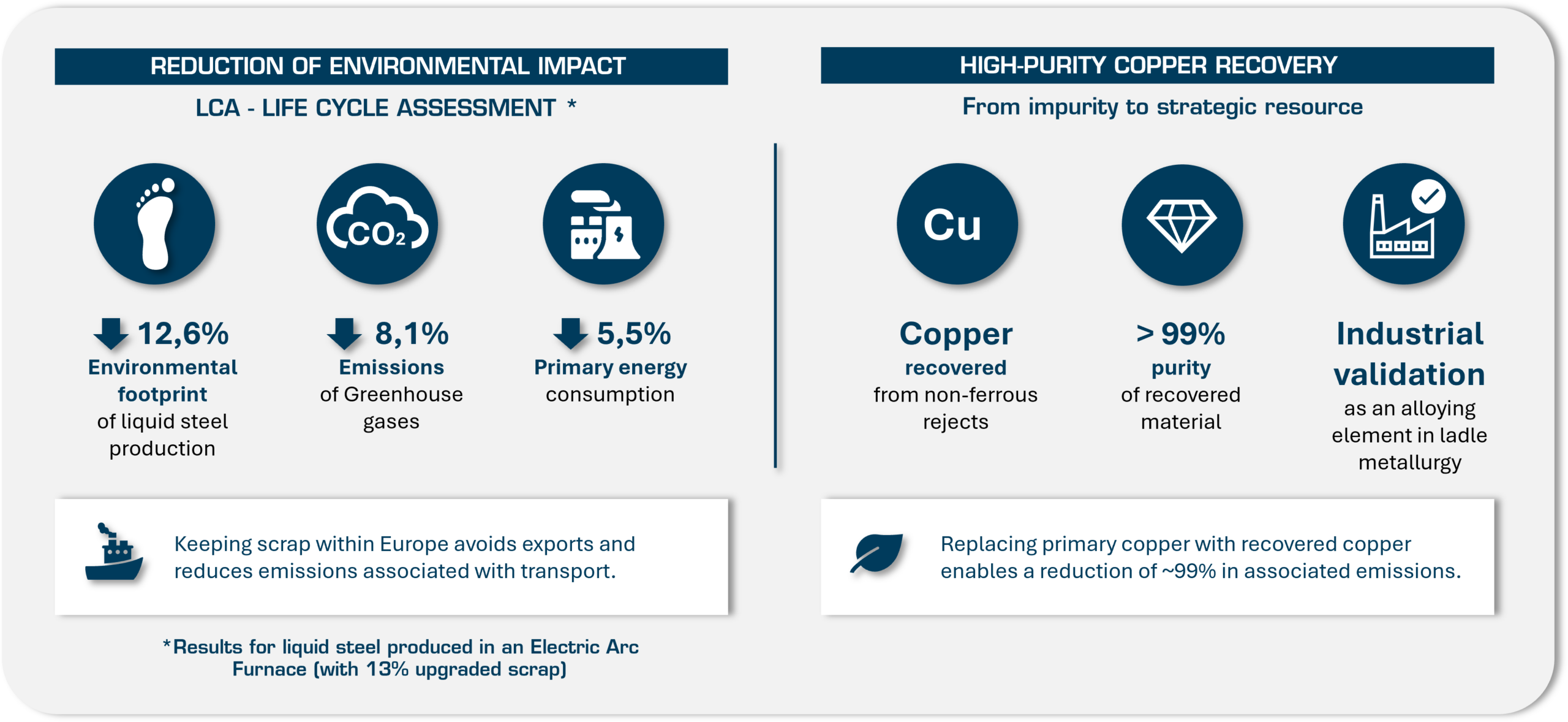
Ovierview of the main results obtained within CAESAR project
Much more than an industrial demonstration
Alongside these industrial demonstrations, the consortium’s different research teams tested new pilot- and industrial-scale methodologies to gain a deeper understanding of the composition and variability of European scrap streams and to improve their classification using optical sensors, X-ray technologies, LIBS (Laser-Induced Breakdown Spectroscopy) and intelligent data analysis systems.
The project also advanced technologies for the online measurement and determination of the volume and density of scrap loads in trucks and charging baskets through the processing of data obtained from cameras and laser scanners.
The reintegration of copper recovered from scrap-cleaning rejects into steel production via the integrated route has been the project’s most successful demonstration of steelmaking residue valorisation, progressing from laboratory validation to industrial-scale trials. At the same time, CAESAR also investigated, at pilot scale, new valorisation routes for other fractions recovered during the scrap upgrading process, including aluminium, plastics and mineral materials, moving towards the almost complete utilisation of all recovered materials.
Overall, the results of CAESAR demonstrate that low-quality scrap can become a strategic source of secondary raw materials for Europe, increasing the availability of recycled feedstock for the production of high-performance steels, reducing dependence on virgin resources and contributing to a more competitive, circular and sustainable European steel industry.
The AZTERLAN researcher concludes that “the circular economy is not simply about recycling more. It is about preserving the highest possible value of every material for as long as possible. That is precisely the shift in perspective that we have sought to demonstrate through CAESAR.”
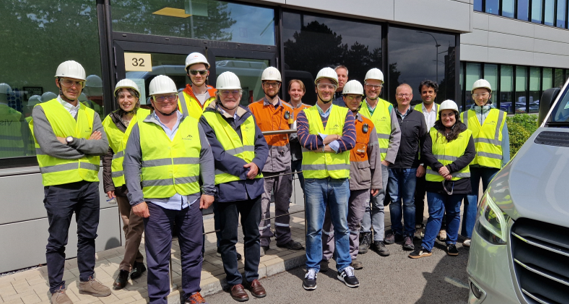
Representatives of the CAESAR consortium during the project’s final meeting, held at the facilities of ArcelorMittal Belgium.
About the CAESAR project
The CAESAR project (CirculArity Enhancements by Low-quality Scrap Analysis and Refinement), funded by the European Union under Grant Agreement No. 101058520, brought together research organisations, recycling companies and steel producers from several European countries with the aim of developing new solutions for a more sustainable, competitive and circular European steel industry.
The consortium comprised Centre de Recherches Métallurgiques, ArcelorMittal Basque Country Research Centre, ArcelorMittal Maizières Research, Rolanfer Recyclage, OTUA Group (Reydesa Recycling and INATEC), ArcelorMittal Belgium, ArcelorMittal Belval & Differdange, AZTERLAN Metallurgy Research Centre, KU Leuven, ArcelorMittal Sestao, ArcelorMittal France and TOMRA Sorting.