

Within the framework of the H2micro workshop, held at AZTERLAN, representatives from industry, technology centers and universities shared the latest advances in the characterization, behavior and embrittlement of materials in contact with hydrogen, as well as the main current and future challenges and lines of work in this field.
As a metallurgy research center specialized in the relationship between metallurgy, processes and in-service properties, AZTERLAN devotes significant efforts to the study and control of material behavior in hydrogen environments, including degradation mechanisms and the development of tailored materials and coatings. AZTERLAN is also a co-founder of the HYMAT group together with the University of Oviedo and its Materials Department in Gijón, an initiative that strengthens scientific and technological collaboration around this energy vector.
Organized by the AZTERLAN Metallurgy Research Center and the University of Oviedo, with the support of the Tabira Foundry Institute and the collaboration of LECO, the H2micro workshop “Interaction of hydrogen with microstructure and mechanical properties” was held on April 23. The session was structured around several presentations delivered by representatives from the University of Burgos, Centre des Matériaux (Mines Paris – PSL), CIEMAT, Tubacex, Enagás, the University of Oviedo and AZTERLAN.
The high level of participation recorded during the event highlights both the growing interest in this field and the need to strengthen collaboration across the entire value chain of the energy industry. In this regard, cooperation between companies and innovation agents is consolidating as a key driver towards a safe and viable hydrogen economy.
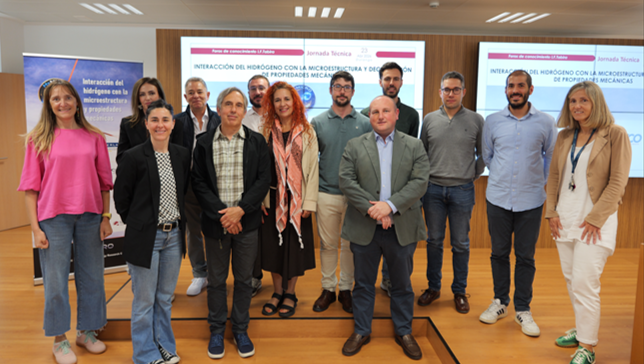
Organizers and speakers at the H2micro workshop.
Following a brief introduction of the company by Leticia García González (Sales Director Spain & Portugal at LECO), the technical session began with the presentation “LECO applications for hydrogen determination and related parameters. GDS Technique for hydrogen depth profiling”, delivered by Pablo Sala (Sales Engineer at LECO) and Stefan Boehm (European Field GDS Product Specialist at LECO). They addressed advanced techniques for hydrogen characterization in metallic materials and its depth distribution. Firstly, Sala introduced the main hydrogen analysis technologies byLECO, highlighting three approaches: inert gas fusion, hot extraction and glow discharge spectroscopy (GDS). He explained how the first two allow quantification of total hydrogen content and even differentiation between diffusible and trapped fractions through thermal ramps, while GDS goes further by enabling depth concentration profiling through layer-by-layer argon plasma sputtering.
From an applications perspective, the LECO expert emphasised that hydrogen measurement provides not only a quantitative value but also key information on material quality, defect levels, the presence of inclusions or porosity, and the potential formation of compounds such as hydrides. He also highlighted its usefulness for evaluating the effectiveness of dehydrogenation treatments, raw material quality, coating adhesion and predicting mechanical behavior against phenomena such as hydrogen embrittlement, as well as for industrial process validation and control.
Subsequently, Stefan Boehm presented the practical application of GDS for hydrogen depth analysis in steels, describing the challenges associated with small samples and their preparation through copper mounting without altering hydrogen content. He explained the operation of the glow discharge system with high spectral resolution and its capability to perform nanometric, element-by-element depth profiling. The results showed that hydrogen concentration is higher at the surface and decreases with depth, with intermediate layers and possible structural heterogeneities being identified.
In conclusion, he stated that combining LECO and GDS techniques enables complementary characterisation: while conventional analysers quantify total hydrogen and its state, GDS provides spatial distribution information. This opens the door to a more comprehensive understanding of hydrogen diffusion and trapping mechanisms, as well as new possibilities in quality control, failure analysis and the development of more embrittlement-resistant materials.
Next, Borja Peral (University of Oviedo) delivered the presentation “SIMUMECAMAT and the phenomenon of hydrogen embrittlement in various metallic alloys: from microstructure to damage”, focusing on the key role of microstructure. After introducing the SIMUMECAMAT group, part of the Gijón School of Engineering, he described its main capabilities in hydrogen characterisation, TDA techniques, electrochemical permeation and mechanical testing, with a strong emphasis on the relationship between microstructural traps, hydrogen diffusion and mechanical response.
The core of the presentation addressed how microstructure controls hydrogen damage, distinguishing between reversible and irreversible traps and their impact on effective diffusion. Peral shared analyses on different systems (ferritic, duplex and austenitic steels), showing how precipitates, dislocations, ferrite-austenite interfaces or stable phases modify hydrogen accumulation and can lead to different fracture mechanisms. He emphasised that it is not sufficient to consider global parameters such as strength or yield stress; it is essential to characterise both trap energy and microstructural geometry.
He also presented experimental examples where hydrogen affects materials very differently depending on alloy and microstructure, including fatigue, slow strain rate and fracture tests, as well as TDA analyses and diffusion models. He highlighted that hydrogen embrittlement is a multiscale phenomenon governed by the interaction between diffusion, plasticity and microstructure, and that designing resistant materials requires controlling both chemistry and microstructural architecture.
Next, AZTERLAN researcher Ibon Miguel presented a study focused on hydrogen embrittlement in ultra-high-strength steels used in aeronautical applications, particularly in critical components such as landing gear. The main issue is that these steels require anticorrosion coatings, but electrodeposition processes introduce hydrogen into the material, increasing embrittlement risk. Cadmium has traditionally been used due to its good protection and low hydrogen generation, but its toxicity and regulatory restrictions have driven the transition towards Zn-Ni coatings, an area in which AZTERLAN has worked within the H2free project.
Miguel shared the results of the research, analysing how different Zn-Ni coating conditions affect hydrogen content and mechanical properties. Different coating morphologies (closed, semi-open and open) were generated through variations in current density and rotating electrode speed. Steels such as E35 and Custom 465 were then tested by combining hydrogen measurements with mechanical testing using the Small Punch Test technique, along with dehydrogenation heat treatments to evaluate hydrogen desorption.
The results showed a clear relationship between morphology, hydrogen content and mechanical strength. The open structure exhibited higher hydrogen absorption and variability, although it degassed more quickly, whereas the closed structure maintained the lowest hydrogen levels and provided higher mechanical strength in both steels. It was also concluded that, although heat treatments partially reduce hydrogen, they do not eliminate differences between morphologies; therefore, coating morphology is a critical factor in hydrogen embrittlement, with more closed structures being the most favourable for safe industrial applications.
The presentation by Luciano Meirelles (Centre des Matériaux – Mines Paris – PSL), titled “Time-resolved hydrogen-induced damage in steel under gaseous H₂, via sub-size tensile testing coupled with in-situ 3D synchrotron tomography”, introduced an advanced experimental approach to study hydrogen-induced damage in steels for energy transport applications. The work is part of the MESAIAH industrial project, focused on monitoring structures using miniaturised specimens to assess the conversion of natural gas networks into hydrogen networks in Europe. Meirelles noted that in France, for example, a significant portion of existing pipelines could be repurposed for hydrogen transport, which requires precise characterization of their behavior.
The researcher described an experimental setup based on in situ tensile testing within a high-pressure chamber (up to 200 bar), compatible with optical techniques and X-ray tomography. This system enables testing of sub-scale specimens while simultaneously observing damage evolution in 3D during deformation. The presented case studies involved ferritic-pearlitic steel specimens subjected to different hydrogen pressures (up to 130 bar) and strain rates, allowing analysis of the material’s sensitivity to embrittlement.
The results showed that both pressure and strain rate significantly influence the nature and distribution of damage. At high strain rates, damage tends to localize at the surface with more brittle behavior, whereas at lower rates hydrogen penetrates more homogeneously, generating both surface and internal damage. Tomography made it possible to distinguish different defect types (surface cracks, internal cracks and microvoids) and quantify their evolution in 3D during testing. It also revealed that internal cracks can act as bridges that facilitate the propagation of surface cracks, contributing to final fracture.
In conclusion, Meirelles highlighted the value of combining miniaturised mechanical testing with in situ 3D tomography to gain a detailed understanding of hydrogen damage kinetics. This approach enables not only the evaluation of material behaviour under realistic service conditions but also the development of predictive models for material selection and the safe repurposing of natural gas infrastructures for hydrogen transport.
In his presentation titled “Hydrogen Technologies Laboratory at UBU: capabilities, research lines and ongoing projects”, Víctor Arniella (University of Burgos) provided an overview of the experimental, simulation and 3D printing capabilities available at the Structural Integrity Group (GIE) of UBU. Regarding hydrogen-related infrastructures, he described their characterisation capabilities and emphasised the use of advanced 3D printing technologies that enable the fabrication of materials with high microstructural control, producing materials resistant to hydrogen embrittlement.
Arniella also presented ongoing projects at the University of Burgos related to hydrogen, including the evaluation of pipeline steels, the behaviour of hydrogen-methane mixtures to reassess current gas distribution infrastructure, and the study of coatings as potential mitigation solutions against embrittlement. He also highlighted work on developing numerical models to predict hydrogen-induced damage and material susceptibility, as well as more advanced projects focused on designing new alloys and microstructures through additive manufacturing.
Susana Merino (CIEMAT) focused her presentation on “Characterisation of hydrogen-induced damage in the crystal lattice through nanoindentation and SEM-EBSD”, addressing the multiscale study of hydrogen effects in metallic materials used in energy applications, aiming to understand how hydrogen modifies local material behavior.
Merino presented studies conducted on different stainless steels and pipeline steels (austenitic, ferritic and duplex), analysing their response after electrochemical and gaseous hydrogen charging. Techniques included hydrogen quantification, nanoindentation tests to measure hardness and elastic modulus at the micrometric scale, and EBSD to correlate mechanical properties with crystallographic orientation. The results highlighted the key role of microstructure in hydrogen damage, showing localised hardening and significant variations depending on hydrogen penetration and grain orientation.
Finally, the CIEMAT researcher emphasised the relevance of combining nanoindentation and EBSD techniques as key tools for identifying local hydrogen-induced hardening mechanisms and, in some cases, microcrack formation. She also underlined the decisive role of crystallographic orientation in damage initiation. Overall, the presentation concluded that these techniques enable progress in the design of metallic alloys and optimisation of surface treatments, such as laser modification, to mitigate hydrogen embrittlement in energy infrastructures.
Victoria Astigarraga (Tubacex Innovación) presented an experimental study on the behaviour of different stainless steels under hydrogen embrittlement: a high-nickel austenitic 316L steel, a high-manganese austenitic steel, and a duplex 2205 steel, each with different microstructures and mechanical properties.
The methodology was based on Slow Strain Rate Testing (SSRT) on specimens previously charged with hydrogen using two methods: electrochemical pre-charging and high-pressure, high-temperature gas charging. Mechanical response was then evaluated in an inert atmosphere at room temperature, with hydrogen content measured before, during and after testing. The embrittlement criterion used was the relative reduction in area (RRA), complemented by fractographic analysis.
The results showed that austenitic steels (316L and high-manganese) maintained ductile behaviour even at high hydrogen contents, particularly in gas charging conditions, where concentrations of up to 80 ppm were reached without significant evidence of embrittlement. In contrast, duplex 2205 steel exhibited embrittlement under both charging methods, more pronounced in gas charging, with low RRA values and brittle cleavage fractures. Astigarraga concluded that microstructure type and charging method strongly influence hydrogen absorption and distribution, with austenitic steels being the most resistant and duplex steels the most susceptible under the tested conditions.
The workshop concluded with the presentation by Iván Montero (ENAGAS), who provided an overview of the development of Spain’s hydrogen transport network and its connection to the future European network. Montero explained Enagás’ role as technical manager of the gas system and its recent designation as provisional hydrogen network operator in Spain, as well as its participation in Projects of Common Interest (PCI) of the European Union. In this context, he highlighted the importance of the Iberian corridor within the European “hydrogen backbone” initiative, aimed at transporting hydrogen from the Peninsula to major demand centers in Europe.
In the Spanish case, Montero detailed the planning of an internal network structured into five main axes (Vía de la Plata, Levante, Ebro Valley, Cantabrian Coast and a transversal axis), with around 2,600 km of pipelines and an estimated investment of nearly €4 billion. The project is currently in the basic and detailed engineering phase, with the aim of making the final investment decision in 2027 and entering operation by 2030.
In his presentation, Montero also addressed the main technical and regulatory challenges, with particular emphasis on adapting existing infrastructures for hydrogen transport. He also stressed the need to develop new integrity assessment methodologies, along with updating European and national regulations. Montero highlighted the importance of digitalisation, particularly through the use of BIM, as well as public participation and collaboration with technology centres and universities, as key elements to ensure the development of a safe, scalable network aligned with future European decarbonisation standards.