
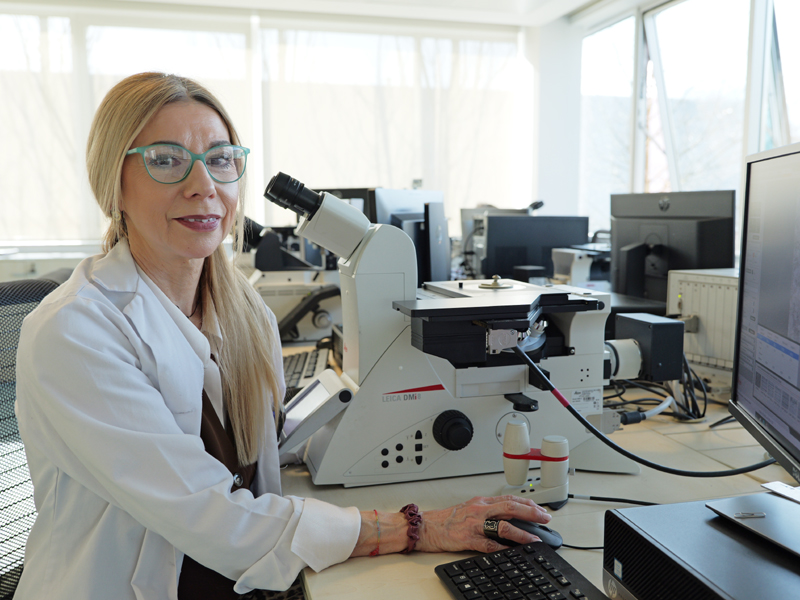
Marta González is a metallurgical analyst and an expert in service failure diagnosis and analysis. Since joining AZTERLAN in 1990, her professional career has been marked by continuous learning, technological adaptation and direct contact with industry. Holding a degree in Chemical Sciences, she found at AZTERLAN the balance between scientific rigor and the practical application of knowledge.
More than three decades later, her path also reflects the evolution of a sector that has undergone profound technological and social changes, and she is one of those “role models” who make visible the important space women occupy in the scientific and technical fields. On Women’s International Day we share part of her path and her vision on the space occupied by women in technological and industrial fields.
What is your role at AZTERLAN and what is your academic background?
I am a metallographic analyst and an expert in service failure analysis and diagnosis, as well as in the analysis of defects in metallic materials. Throughout my professional career I have worked in the areas of mechanical properties (where I initially joined in 1990) and metallographic analysis, where I ultimately specialized.
The metallography area at AZTERLAN is characterized by integrating the entire analytical process carried out on a material or component. In other words, it is where we perform the joint interpretation of the different characterization works. Based on this knowledge and on the fact that I have specialized in steels throughout my career, I also focus on service failure analysis (components that fail during their useful life) and have participated in R&D projects. All of this has given me a broad view of materials and their manufacturing processes.
Regarding my academic background, I earned a degree in Chemical Sciences, specializing in Physical Chemistry. Afterwards, I completed doctoral courses and received university grants, where I planned to remain for at least four more years. However, at that time the opportunity arose to join AZTERLAN, and I decided to take that step.
How would you describe your professional career so far?
I think it has been very positive and enriching. It has based on a progressive evolution. When I arrived at AZTERLAN, I had a scientific and theoretical background but no industrial experience. Most of the knowledge I now have about materials and the processes used in their manufacturing was acquired here.
My professional growth has paralleled AZTERLAN’s own development, adapting to technological advances, new methodologies and increasing demands from the various industrial sectors we work with, always striving to provide solutions to their daily challenges. There have been easier moments and others more demanding, but I have always felt that I was moving forward, acquiring new knowledge and adding value.
Images of Marta in the AZTERLAN laboratory in the early 1990s.
How do you remember your early years at AZTERLAN?
I remember them with great enthusiasm and a strong desire to learn, being part of a team that was deeply committed and excited about the project. From that time, I also recall feeling that they believed in me, that they were investing in me and dedicating time to my training. I could clearly see the opportunities for growth that I would have here, and that was very motivating.
It is an experience I wish everyone who has joined the AZTERLAN team at any time over these 40 years could have lived, although I am aware that the organization’s current size and pace are very different from what they were when I joined.
Did you imagine that AZTERLAN could achieve this level of development over 40 years?
Honestly, no. When I joined, the team was small and technological capabilities were those of a young centre. Over time, AZTERLAN has grown in people, specialization and technical resources. Beyond the technological advances in our field, the capabilities we have developed, together with our structural growth, were unimaginable at that time.
There have been periods of steady growth and others of rapid expansion, but evolution has been constant. I feel part of that journey and experience it as my own project, like someone who has watched a baby grow. It is also important to remember that there has been a strong driving force guiding it wisely, and that we have worked hard and dedicated great effort throughout these years.
Throughout your career you have maintained close contact with industry. How do you perceive the presence of women in the metal-mechanical sector?
Although there were women studying technical degrees in the educational and academic sphere, their presence in industry was very limited. When I started, it was common for the counterparts in industrial companies to be men, especially in technical and managerial positions. It was also the broader context of that time.
Over the years, this reality has gradually changed. Today it is much more common to find women in these roles, particularly in quality and technical office positions. It has not been a radical or immediate transformation, but rather a progressive one. Thirty years may seem like a long time, but in cultural terms it is not that much, and the change is clearly visible.
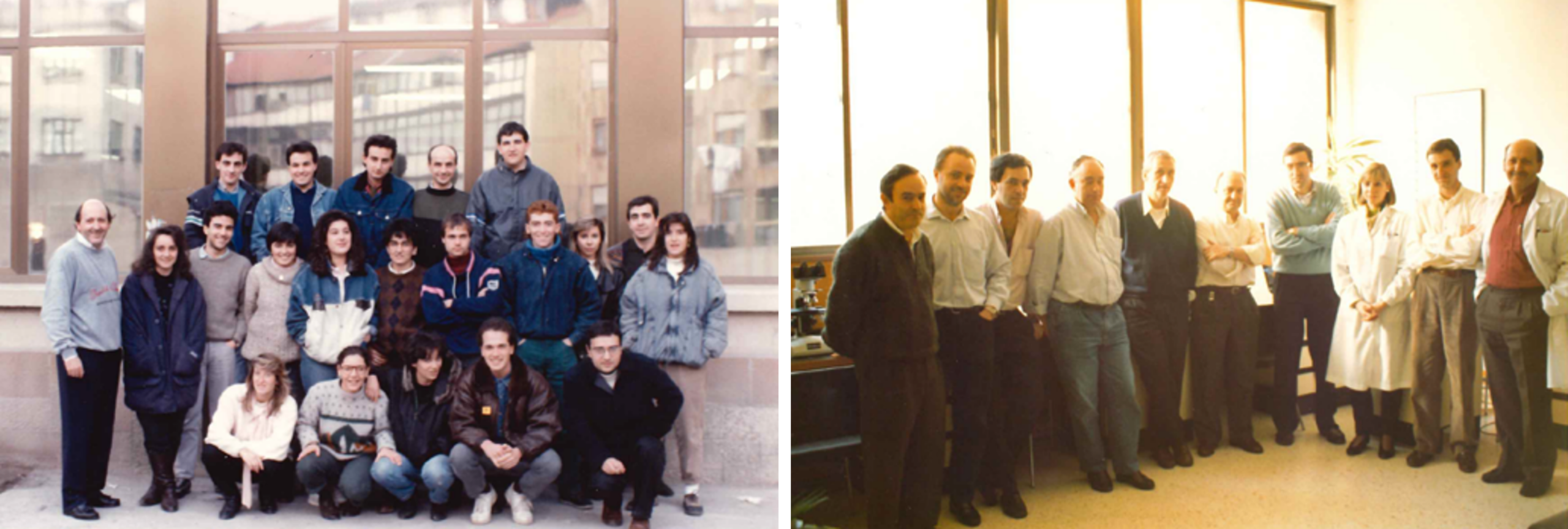
Left: Marta González, Julián Izaga, and Ricardo Gezala (AZTERLAN) participate as instructors in a technical course related to foundry work.
Right: Marta and Julián accompany a group of technicians from a client company at the AZTERLAN facilities.
Have you ever felt limited or conditioned by your gender, either in choosing your studies or in your professional career?
Personally, no. In my family environment, it was never suggested that I might face limitations for being a woman. The message was clear: education was an investment in myself, something no one could take away and that would open doors. I have always had a natural inclination toward technical subjects, and when I chose a technical degree, I always felt supported.
When I joined AZTERLAN, we were eight people on the team, four of whom were women. These percentages were unimaginable in an industrial environment at that time. Throughout my career, I have not felt directly conditioned either. At AZTERLAN and previously at university, I have always perceived that knowledge and the ability to solve problems were valued.
In my dealings with industrial counterparts, I have not experienced gender bias. Companies came to AZTERLAN seeking help with their problems, and they respected us to the extent that we were able to solve them or at least guide them toward a solution. Ultimately, that was what mattered most.
Women remain underrepresented in technical degrees and professions. Why do you think this is the case? What can be done to change that?
I believe it is largely related to cultural and educational factors. Often, without even realizing it, we transmit certain roles or expectations from a very early age. That is why I think the foundation lies in education, especially within the family environment: educating in equality and offering children the full range of options without limiting interests.
It is important that both girls and boys can explore what sparks their curiosity, free from prior labels. If from an early age it is normalized that any educational or professional path is valid for both genders, access to technical careers will be a natural consequence.
In addition, social policies that facilitate work-life balance also help ensure that professional decisions are not so heavily conditioned by other factors. Deep changes like these are not achieved overnight, but with education, role models and opportunities, balance will progressively be reached.
Likewise, I believe that initiatives such as visits by young students to AZTERLAN (or other centres and workplaces) contribute to this mission by making visible potential professions that may interest them in the future.