

The positioning of hydrogen as an energy vector entails significant technological challenges associated with the application and development of materials that must operate in contact with this element. Improving knowledge related to the behavior and durability of these materials under different operating conditions is essential for developing components that must operate safely in hydrogen atmospheres.
With this focus, the “1st National Meeting on Materials in Contact with Hydrogen” brought together technical and research personnel specialized in this field. The AZTERLAN Metallurgy Research Center had a prominent presence in this technical framework through the participation of Garikoitz Artola, Head of Forming Technologies, and Enara Mardaras, Head of Corrosion R&D, on the scientific committee of this significant technical event. They also shared part of their research work in the official meeting program with presentations by both researchers and participation in three other papers shared at the meeting.
Enara Mardaras presented the study carried out to understand the permeation of high-strength steels in the marine environment. “Ultra-high-strength steels (UHSS) are increasingly used in the manufacture of structures for marine or offshore wind power generation because they offer exceptional mechanical properties. However, these steels are susceptible to hydrogen embrittlement.” Given this situation, it is common to heat-treat these steels to optimize their microstructure and their response to hydrogen absorption. “In order to understand how hydrogen interacts with the crystal lattice of these materials, within the H2MAT+ project we studied the hydrogen diffusion kinetics of three high-strength quenched and tempered steels in a synthetic marine environment. We have verified that there is a relationship between the yield strength of the material and its capacity to absorb hydrogen; we also found that it is possible to modulate the microstructure of these materials to modify the hydrogen diffusion kinetics.”
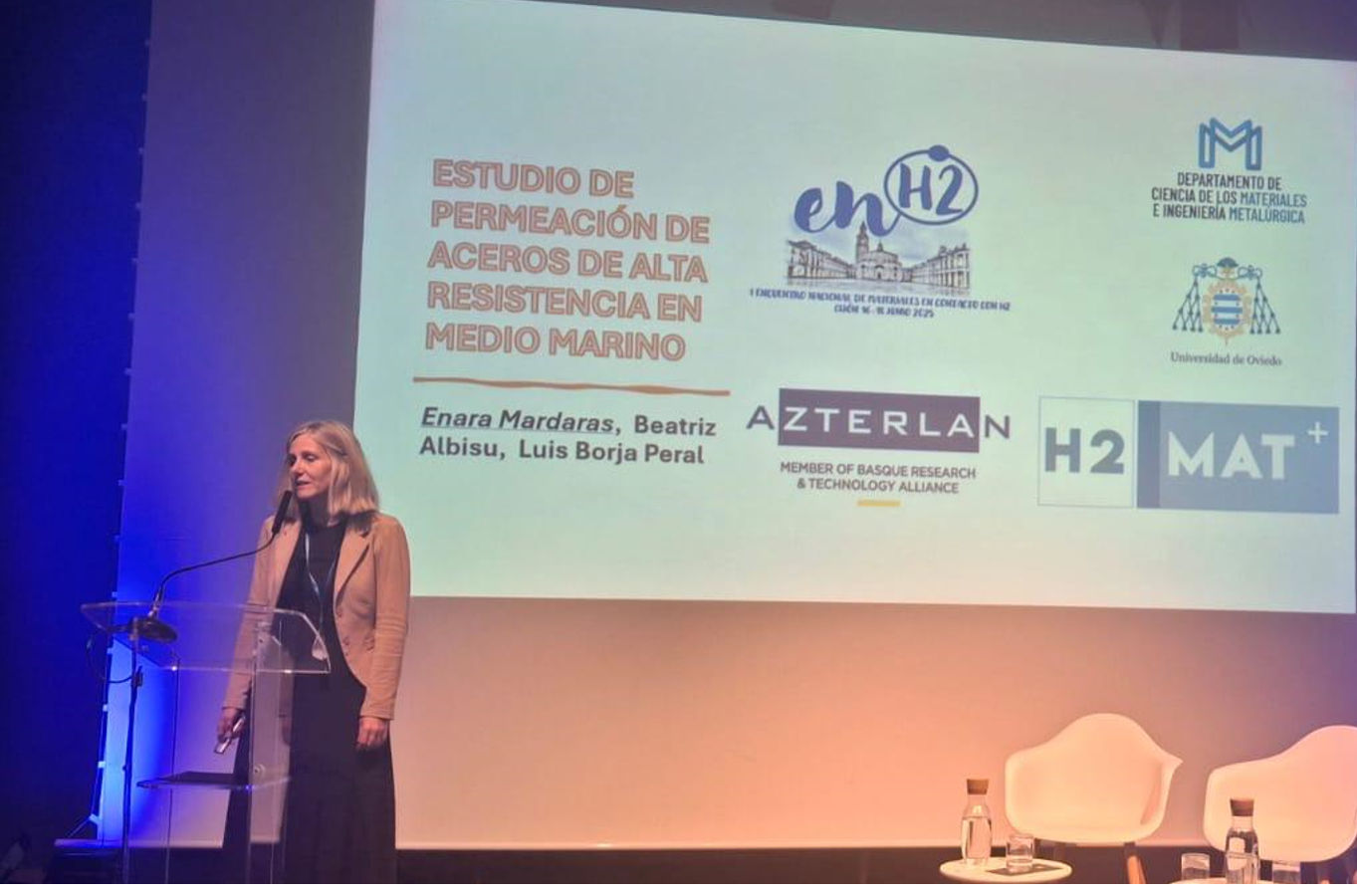
PhD. Enara Mardaras sharing the results of the permeation study of UHSS at ENH2
For his part, Garikoitz Artola presented the work “Set Ups for SPT at cryocompressed hydrogen temperatures”, where he explained how it is possible to rationalize the consumption of liquefied gases used to carry out low-temperature tests, “aimed at investigating the mechanical properties of materials used to manufacture elements such as tanks, tubes or valves, among others”, combining the reduction of the mass of test tools and the use of miniaturization offered by Small Punch Testing (SPT). Among other key points, the AZTERLAN researcher highlighted the application of the finite element method (FEM) as a tool to avoid having to perform tractions to adjust SPT coefficients with a much greater consumption of resources.

PhD. Garikoitz Artola focused on SPT technique to investigate the mechanical properties of materials
Participation through papers presented by other stakeholders
The research work of AZTERLAN team was also present in the studies presetend by other organizations:
➡️ “A comparative study of hydrogen trapping kinetics and embrittlement susceptibility of additively manufactured and wrought 316L austenitic stainless steel: influence of post-processing”, developed in conjunction with the University of Oviedo and presented by Luis Borja Peral.
➡️ “Surface Modification by Shot Peening to Enhance Hydrogen Embrittlement Resistance in Steels for Hydrogen Distribution” developed in conjunction with the University of Oviedo and presented by Marcos Bueno.
Finally, the meeting also featured a presentation developed within the NEXTsteel project. In this case, the presentation of the work on the study of the corration betwwn microstructure and hydrogen permeability in high resistance steels under different tempering conditions” was led by researcher Francisca García Caballero from CENIM-CSIC. AZTERLAN participates in the NEXTsteel project (CPP2021-008415) led by PYRSA (Italtractor ITM SpA) and funded by MCIN/AEI/10.13039/501100011033 and by the European Union NextGenerationEU /PRTR.