Safer, cleaner materials and processes to protect workers’ health
“BRISA – Breakthrough Research on Industrial Safety against Airbone Carcinogens and Emerging Pollutants” tackles the urgent challenge of carcinogenic and emerging airborne industrial pollutants, linked to 53% of occupational cancers in the EU and 125,000 premature deaths annually.
Energy-intensive industries remain key emitters of airborne hazardous pollutants, where current prevention strategies, monitoring methods, and regulatory frameworks are insufficient.
BRISA aims to advance scientific knowledge and demonstrate safe, clean industrial technologies through a ground-breaking, multi-layered methodology designed to systematically tackle Carcinogenic and Emerging Priority Industrial Pollutants (CEPIPs) and thereby reduce risks to human health and biodiversity.
Even though the need to reduce airborne hazardous pollutants is a clear priority for European process industry, compliance remains difficult, particularly for SME: the substitution of hazardous inputs or process redesigns often lack cost-effective alternatives that maintain functional performance and durability, safeguard recyclability, keep production costs within target bounds, and deliver verified risk reduction. Furthermore, monitoring and stack sampling methods for emerging pollutants are still scarce, technically complex and cost prohibitive. In parallel, tools for effective training and participatory risk governance under real operating conditions are still underdeveloped.
These interconnected gaps hamper the full implementation of regulatory requirements, allowing risks to human health and biodiversity to persist, while limiting the integration of innovation, circularity and safe-and-sustainable-by-design approaches.
BRISA aims to advance scientific knowledge and demonstrate safe, clean industrial technologies through a ground-breaking, multi-layered methodology designed to systematically tackle Carcinogenic and Emerging Priority Industrial Pollutants (CEPIPs) and thereby reduce risks to human health and biodiversity. BRISA projects results are explicitly designed for SME uptake, ensuring impact beyond the consortium by strengthening their competitiveness and innovation capacity.
TARGETED CEPIPs:
Established occupational hazards:
Respirable Crystalline Silica (RCS)
Volatile Organic Compounds (VOCs)
Brominated Flame Retardants (BFRs)
Bisphenols (BPs)
Polycyclic Aromatic Hydrocarbons (PAHs)
Emerging pollutants
Per- and Polyfluoroalkyl Substances (PFAS)
Incidental Nanoparticles (INPs)
Ultrafine particles, including microplastics (UFPs)
Specific objectives
Build a cross-sector regulatory and exposure intelligence baseline to steer SSbD-aligned design and compliance for CEPIP-targeted innovations
Develop SSbD-guided at-source mitigation routes in materials and processes to minimise CEPIP formation and enable safe deployment
Develop and demonstrate an integrated AI-enhanced monitoring and predictive risk-management ICT system for CEPIPs to enable early warning, proactive control and operational readiness
Embed human factors in adaptive CEPIP protection by integrating real-time alerts with co-designed protocols and immersive training to maximise adoption and effectiveness
Demonstrate the overall benefits, performance and effectiveness of all the components under relevant conditions to facilitate the industrial adoption
Deliver a comprehensive SSbD and sustainability assessment framework that validates BRISA’s safety and sustainability advantages and enables market uptake and policy alignment.
Expected results
FAIR compliant database & protocol package.
Portfolio of sector-specific innovative products and knowledge transference packages.
Smart low-cost sensing units integrated into a IoT infrastructure composed by a modular architecture.
Digital twins.
Adaptative protection framework integrates human-centred approaches throughout the project life cycle.
Pilot validation (experimental protocol): Validation across five pilots is based on standardisation and comparability.
Policy and replication pathways (translational methodology).
Validation is extended to systemic uptake through policy and replication methodologies.
A science-based, multi-layered methodology
Approach
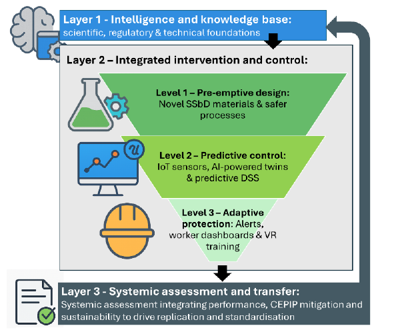
BRISA proposes a paradigm shift in industrial safety management by reframing the Hierarchy of Controls (HoC)—often applied as a static compliance checklist—into a dynamic, data-driven and adaptive cycle that is continuously informed by iterative application of Safe and Sustainable by Design (SSbD) principles.
This approach embeds hazard minimisation, process safety and sustainability from early design through to a continuous risk assessment, while preserving the HoC logic that prioritises elimination, substitution and engineered prevention at source.
Translation of the Layer-1 baseline into interventions aligned with HoC:
Upstream elimination/substitution via SSbD formulations, process redesign and source-level engineering to reduce CEPIP emissions
Predictive control: continuous observability and forecasting through modular multi-CEPIP monitoring and AI-powered digital twins with real-time risk management
Adaptive protection: conversion of predictive intelligence into task-specific alerts, decision-support interfaces and immersive training tools
Pilots in ceramics, foundry, mineral fillers, ELT and plastics recycling industries to ensure combining TRL6 demonstrations with sustainability, tox/ecotox datasets, technoeconomic analysis, and a quantitative SSbD scoring framework.
5 pilots covering different industrial sectors
Demonstrator pilots
Pilot 1: Ceramic Industry
ARC’s spray-dried ceramic powder plant (Spain).
Targeted pollutants: RCS, INPs.
Expected impact (KPIs):
100% substitution of quartz sands;
RCS ≤0.03 mg/m³ (8 h TWA);
short-term ≤0.05 mg/m³ (15 min);
INPs ≈4×10⁴ cm⁻³ and ≥30% peak reduction via adaptive LEV; EN-ISO 14411 performance preserved at ≤€80/t;
Real-time RCS benchmarked (gravimetry, XRD);
stack methods and systemic assessment validated;
DT validated (≥3 zones; Pearson r ≥0.85).
Pilot 2: Foundry
BUC’s sand casting foundry (Germany).
Targeted Pollutants: RCS, VOCs including FA.
Expected impact (KPIs):
50-100% substitution of APNB/FNB binders and 70-100% of quartz sand;
>70% occupational RCS reduction;
≥50% VOC/FA reduction;
validated CS<20% sands and bio-binders (<20–50% phenol/FA) with ≤3% cost increase (ref. €110/t APNB);
6% casting rejects;
90% sand recyclability maintained/improved;
Real-time systems benchmarked;
DT validated (≥3 zones; r ≥0.85).
Pilot 3: ELT recycling
ORZEŁ’s facilities (Poland).
Targeted Pollutants: UFPs, VOCs, PAHs and PFAS.
Expected impact (KPIs):
recycled polyester fiber with ≥60% reduction in PAH-rubber contamination;
Funded by the European Union (GA No. 101294264). Views and opinions expressed are however those of the author(s) only and do not necessarily reflect those of the European Union or the European Health and Digital Executive Agency (HADEA). Neither the European Union nor the granting authority can be held responsible for them.
We use cookies to help you navigate efficiently and perform certain functions. You will find detailed information about all cookies under each consent category below. The cookies that are categorized as Necessary are stored on your browser as they are essential for enabling the basic functionalities of the site. We also use third-party cookies that help us analyze how you use this website, store your preferences, and provide the content and advertisements that are relevant to you. These cookies will only be stored in your browser with your prior consent. You can choose to enable or disable some or all of these cookies but disabling some of them may affect your browsing experience.
Necessary
Always active
Necessary cookies are required to enable the basic features of this site, such as providing secure log-in or adjusting your consent preferences. These cookies do not store any personally identifiable data.
Preferencias
El almacenamiento o acceso técnico es necesario para la finalidad legítima de almacenar preferencias no solicitadas por el abonado o usuario.
Functional
Functional cookies help perform certain functionalities like sharing the content of the website on social media platforms, collecting feedback, and other third-party features.El almacenamiento o acceso técnico que se utiliza exclusivamente con fines estadísticos anónimos. Sin un requerimiento, el cumplimiento voluntario por parte de tu proveedor de servicios de Internet, o los registros adicionales de un tercero, la información almacenada o recuperada sólo para este propósito no se puede utilizar para identificarte.
Analytics
Analytical cookies are used to understand how visitors interact with the website. These cookies help provide information on metrics such as the number of visitors, bounce rate, traffic source, etc.