

Launched in 2022, CIRCOM has addressed a dual environmental need in the metalworking and construction sectors, both of them high-impact industries that inherently generate a large amount of waste in their production processes. Throughout its development, CIRCOM has worked on obtaining new molding materials (alternative binders and aggregates) and sustainable cementitious materials from steelmaking slag and construction and demolition waste (CDW), using alkaline activation technology. The project is currently in its final phase, centered in the implementation of full-scale demonstrators in industrialized environments.
Using alkaline activation technology, CIRCOM has worked to obtain new sustainable molding and cementitious materials from steelmaking slag and construction and demolition waste (CDW). This approach has led to progress in innovative alternatives that reduce the consumption of natural raw materials, reduce the environmental footprint of cement-based materials, and contribute to the circular economy in two of the most relevant industrial sectors.
In the second year of the project, key advances were made at the laboratory level, with the creation and optimization of various sustainable solutions tailored to the defined use cases:
- Casting molds: Development of a cement- and resin-free material based on a binder-sand system manufactured entirely from the recovery and conditioning of black slag.
- Refractory concrete: Design of a cement-free refractory concrete with high mechanical and thermal strength, obtained through alkaline activation of black slag.
- Sustainable Mortar: Development of a mortar based on the recovery of CDW, applying an optimized alkaline activation process to the useful fractions of said waste.
Currently in its third year, CIRCOM is in the final phase of the project, with the implementation of full-scale demonstrators in industrialized environments:
- At Reinosa Forgings and Castings (RFC), casting molds with alternative binders and aggregates have been developed and validated under real-life conditions.
- At Cantera La Torreta, bricks for construction have been manufactured based on recycled material, with a lower carbon footprint than conventional Portland cement and without diminishing their mechanical and functional properties.
The CIRCOM team positively values the results obtained and believes they mark a decisive step toward the industrial application of the developed materials. In the words of Lucía Unamunzaga, head of AZTERLAN’s Sustainability and Environment research line, “After demonstrating that alkaline activation technology is a promising avenue for the recovery of these important waste streams and the development of more sustainable molding systems, identifying lower-cost alkaline activators and developing demolding solutions that facilitate greater recyclability are significant challenges to address. Both aspects will be crucial for moving toward broader industrial implementation of this technology.”
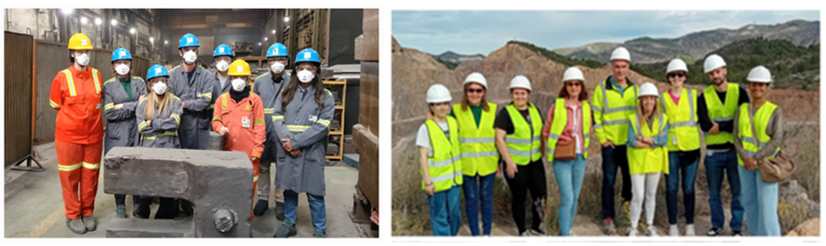
CIRCOM’s team at RFC and Cantera La Torreta facilities at different stages of the project.
CIRCOM has a multidisciplinary and cooperative consortium made up of the companies REINOSA FORGING & CASTINGS, S.L., coordinator of the project, and CANTERA LA TORRETA, S.A., and the Technology Centers AIMEN, ITC-AICE and AZTERLAN.
The CIRCOM project with reference CPP2021-008798 is funded by MCIN/AEI/10.13039/501100011033 and by the European Union-NextGenerationEU/PRTR