
The conference “The Future of Foundries: Industry Challenges, Technological Innovation and Funding Opportunities to Drive Transformation” brought together industry professionals at AZTERLAN to reflect on how foundry companies can strengthen their competitiveness in a context shaped by technological transformation, the energy transition, and increasing regulatory pressure.
The event featured contributions from the Spanish Foundry Associations Federation (Federación Española de Asociaciones de Fundidores, FEAF), SAYMA and the AZTERLAN Metallurgical Research Centre, which addressed the future of the sector from complementary perspectives: the challenges facing the industry, the innovation trends shaping its evolution, and the financial instruments available to turn opportunities into real projects.
The conference was opened by Marcial Alzaga, Secretary General of FEAF, who provided an overview of the current state of the European foundry industry and the main challenges affecting its competitiveness. Among the most significant issues highlighted were talent availability, energy and raw material costs, sustainability, digitalisation, international competition, and the impact of the European regulatory framework on industrial activity.
During his presentation, the FEAF representative focused on several regulatory developments that are expected to shape the future of the European foundry industry, including the evolution of the EU Emissions Trading System (ETS), the Carbon Border Adjustment Mechanism (CBAM), the revision of environmental permits under the Industrial Emissions Directive (IED), and the opportunities linked to future European industrial policy through the proposed Industrial Accelerator Act.
Marcial Alzaga (FEAF) presented the current challenges facing the foundry industry
Subsequently, Dr. Susana Méndez, Head of Foundry Technologies at AZTERLAN, presented an analysis of international R&D&I trends in iron, aluminium, and steel casting [download in Spanish here].
Her presentation showed that, despite existing challenges, the industry continues to innovate in order to develop more efficient, sustainable, and competitive processes. Based on an analysis of international scientific activity, European innovation priorities, and the recent evolution of Basque foundries, the presentation identified some of the areas with the greatest potential for the coming years.
Among the topics highlighted by the AZTERLAN expert were artificial intelligence applied to manufacturing processes, digital twins, decarbonisation, the circular economy, and the development of new materials for strategic sectors linked to energy, hydrogen, and electrification. These areas represent not only the main technological trends in the sector, but also significant opportunities to enhance the future competitiveness of foundries.
Dr. Susana Méndez (AZTERLAN) at the start of her presentation
The event concluded with contributions from SAYMA professionals Susana López, Jon Susperregui and Álvaro Narro, who shared strategies for structuring industrial investments from a comprehensive perspective. They also presented a range of financial, fiscal, and innovation support instruments that can facilitate the implementation of business transformation projects. In addition, they offered recommendations on how to maximise access to funding and support mechanisms that can accelerate the modernisation and competitiveness of companies across the sector.
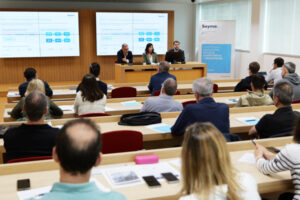
Jon Susperregui, Susana López and Álvaro Narro (SAYMA) during their presentation