
Once again, the World Foundry Congress has brought together professionals, researchers, and companies from around the world to address the key challenges and technological advances shaping the foundry industry. The 76th edition of the congress was held in Turkey, with AZTERLAN making a significant contribution to the technical program.
AZTERLAN’s participation highlights several areas of research and development helping transform the industry: the application of artificial intelligence to manufacturing processes, advanced manufacturing digitalization, and the development of tools to improve process control, quality, and efficiency in foundry operations and their products.
Toward a New Generation of Smart Foundries
During the session Smart Foundries: Advancing Efficiency, Productivity, and Innovation, Susana Méndez presented the contribution “WHEN METAL THINKS. From Isolated Models to Collaborative Intelligence”.
Offering a forward-looking perspective, AZTERLAN’s Foundry Technologies Manager explored how artificial intelligence, physics-based models, industrial knowledge, and human expertise can converge to shape a new generation of intelligent systems capable of supporting decision-making in complex manufacturing environments.
Dr. Susana Méndez shared insights into how the convergence of AI and expert knowledge can support decision-making in manufacturing processes
Advanced Monitoring and Zero-Defect Manufacturing for V-HPDC Processes
During theDie Casting: Technologies, Challenges, and Future Directions session, Asier Bakedano presented the contribution “Data-driven Multivariable Monitoring and Control of Critical Parameters in Vacuum High Pressure Die Casting towards Zero-Defect Structural Components”.
The paper roposes an advanced monitoring strategy for vacuum high-pressure die casting (V-HPDC), integrating multiple process variables to improve diagnostic and control capabilities and provide a better understanding of actual process behavior during the manufacturing of aluminum structural components.
Dr. Asier Bakedano during his presentation on process control in HPDC.
Thermal Analysis for Porosity Prediction in Ductile Iron Castings
As an invited speaker, Ramón Suárez participated in the Advancements in Cast Iron and Cast Steel Technologies session with the contribution “Use of Thermal Analysis for Porosity Prediction in Spheroidal Graphite Iron”.
The research examines the relationship between inoculation, solidification evolution, and porosity formation in ductile iron. It proposes new thermal-analysis-based criteria to optimize casting quality and advance toward more efficient manufacturing processes.
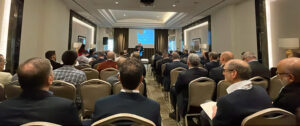
Ramón Suárez during his presentation on thermal analysis as a tool for predicting porosity in ductile iron
Development of aluminum alloys for giga-casting prototyping
AZTERLAN was also represented in the Advancements in Non-Ferrous Casting: Materials and Processes session through its collaboration with KIMURA FOUNDRY (Japan). Representing the Japanese foundry, Takato Homma presented the paper “Improvement of Mechanical Properties of Al-Si-Mg Alloys for Sand Mold Casting in Giga-Casting Prototyping”, developed in collaboration with AZTERLAN’s Light Materials team.
The study addresses the improvement of the mechanical properties of Al-Si-Mg aluminum alloys for prototype manufacturing using sand mold casting, offering an approach to developing components for giga-casting applications. The research examines alloy composition and heat-treatment conditions to achieve a suitable balance between strength and ductility while limiting deformation associated with cooling.
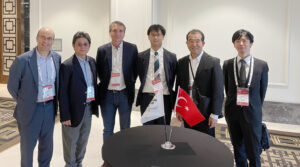
AZTERLAN and KIMURA FOUNDRY team members. Both organizations collaborated on the research presented at the congress.
A Congress of Special Significance for the International Foundry Community
The 76th edition of the World Foundry Congress coincided with the centennial celebration of the World Foundry Organization (WFO), an organization with which AZTERLAN and the TABIRA Foundry Institute have maintained a close working relationship for more than two decades. This milestone marks 100 years of international cooperation, knowledge exchange, and commitment to the foundry industry, which the WFO is celebrating in 2026.
The Congress also included several WFO working meetings, such as the Executive Committee meeting, the General Assembly, and Technical Committee meetings. These gatherings helped strengthen the activities of this prominent international network, whose General Secretariat is coordinated from Durango by José Javier González.
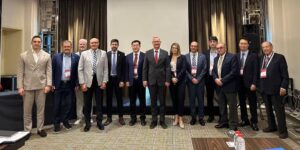
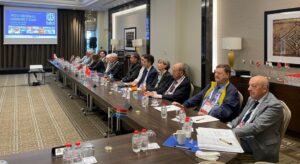
AZTERLAN and TABIRA Foundry Institute members at the WFO Executive Committee meeting and General Assembly.
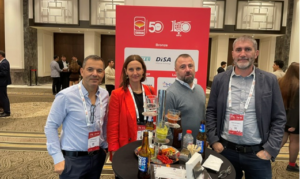
Rpresentatives of Fagor Edertek, Fundigex and Betsaide.
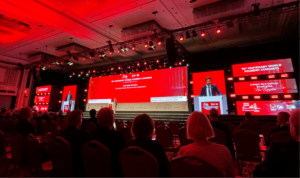
José Javier González during the WFO celebration gala