

EUSKATFUND and AZTERLAN collaborate in the development of knowledge and tools to facilitate the industrial implementation of lower environmental impact moulding systems.
The foundry industry faces a dual challenge: advancing toward more sustainable processes and reducing its environmental impact without compromising product quality or manufacturing competitiveness. In this context, inorganic binder systems represent a promising alternative to the organic resins traditionally used in the production of foundry molds and cores, thanks to their potential to reduce emissions and support more efficient material management.
However, the implementation of these technologies remains limited. The performance of inorganic binder systems is influenced by numerous factors, including environmental conditions, raw material characteristics, and the specific parameters of each production process. This high level of sensitivity makes it difficult for a single formulation to be successfully applied across different foundries and industrial environments.
To address this challenge, EUSKATFUND and AZTERLAN are participating in the DESIA project (Development of Tailor-Made Inorganic Binder Systems for Ferrous Foundries), an initiative aimed at developing a methodology that enables these systems to be adapted to the specific conditions of each facility, thereby facilitating their future industrial deployment.
Throughout the project, EUSKATFUND will lead the development of formulations tailored to different application scenarios, while AZTERLAN will contribute its expertise in materials characterization, experimental design and technology validation. This joint effort will enable a systematic study of how variables such as ambient temperature and humidity, molding sand characteristics, part geometry and dimensions, and curing conditions affect the performance of inorganic binder systems.
One of DESIA’s main objectives is to generate knowledge about the relationship between these variables and the final performance of inorganic binders. To achieve this, the project will combine design of experiments methodologies and testing campaigns aimed at analyzing thousands of potential process parameter combinations. As a result, an experimental database will be created to identify behavioral patterns and establish criteria for selecting the most suitable conditions for each production environment.
This knowledge will serve as the foundation for the development of a digital tool capable of guiding the adaptation of binder systems to the specific conditions of a foundry. The objective is to move beyond approaches that rely primarily on trial-and-error experimentation and case-by-case adjustments towards a more systematic, data-driven methodology that facilitates the transfer of these solutions to new industrial environments.
In addition to the technical validation of the developed formulations, the project will incorporate life cycle assessment methodologies to evaluate their environmental performance. The use of inorganic systems can significantly reduce emissions associated with conventional organic resins and support the recovery and reuse of foundry sands, aspects that are becoming increasingly important in the transition towards more sustainable manufacturing models.
DESIA is aligned with European objectives related to industrial decarbonization, circular economy and efficient resource use. Existing studies show that inorganic binder systems can substantially reduce emissions of volatile organic compounds and other pollutants associated with the foundry process, while also contributing to improved environmental conditions within production facilities.
With an expected duration of 26 months, the project will progressively address the identification of industrial requirements, the development and validation of new formulations, and the creation of support tools for their implementation. Beyond developing new binder systems, DESIA aims to generate knowledge, methodologies and tools that accelerate the adoption of more sustainable moulding technologies, helping to strengthen the competitiveness and innovation capacity of the foundry industry.
DESIA is funded by the Circular Economy Innovation Grants Programme of the Department of Industry, Energy Transition and Sustainability of the Basque Government.
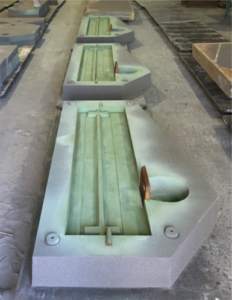
Molds manufactured with inorganic binders in industrial casting process. (Image courtesy of Euskatfund)

