

The AZTERLAN Metallurgy Research Center has successfully manufactured stainless steel components with lattice structures to reduce their weight without negatively affecting their mechanical properties. The parts were manufactured in 3D sand molds constructed using Binder Jetting technology and air-cast using a conventional process.
The manufacture of sand molds and cores using the advanced Binder Jetting manufacturing process allows for the generation of shapes that are not feasible by means of conventional molding systems. In this process, resin is selectively applied to a thin layer of sand, depositing it layer by layer, resulting in a 3D sand mold with a hardness and surface finish similar to those offered by other molding techniques.
The main advantage offered by this technology is the freedom of design that, in turn, opens the door to significant technological innovations linked to both the geometry of the components and the molding means themselves, such as the configuration of the filling and feeding systems.
Based on this technology, and within the framework of the Ecofast2 project, dedicated to the development of Additive Manufacturing technologies, AZTERLAN’s Special Materials and Processes team has successfully manufactured new concepts for lightweight steel components based on lattice/reticular structures. To achieve this, the research team has developed various strategies related to metal conditioning and the development of feeding systems.
As explained by AZTERLAN researcher David García, “In the case of designs with complex lattices and fine channels, such as reticular structures, 3D sand printing allows for the manufacture of molds and cores with complete design freedom. However, the main technological challenge relies in the filling of the parts, that is, ensuring that the moltenmetal flows correctly through the connected channels, feeding the parts, and that parts continue to feed from the risers during solidification.” Otherwise, defects related to insufficient filling or cold joints could appear in the parts, affecting the mechanical properties of the components.
The research team has successfully manufactured the first demonstrators using conventional casting. In a new phase, research efforts will focus on developing new filling concepts, affecting the riser systems, the distribution of parts in the mold, mold orientation, and the incorporation of forced feeding devices, among others.
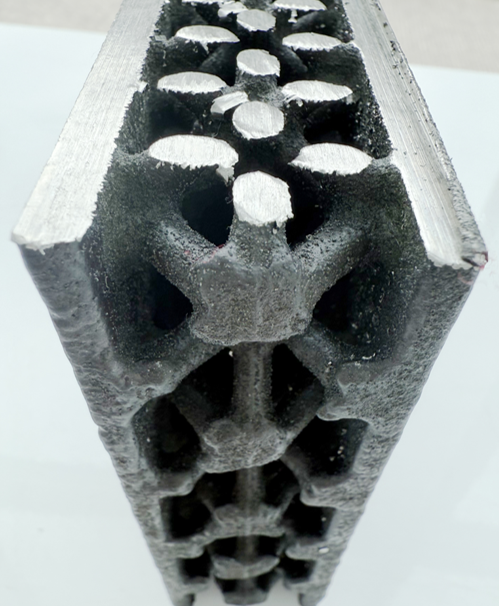
Sample of a lightweight stainless steel component built with a lattice structure by means of 3D printed sand mold.
About the ECOFAST2 project
“ECOFAST2” aims to research and generate knowledge on more sustainable, efficient, and productive metal additive manufacturing technologies for the transformation and generation of a competitive industry with a lower environmental impact. This is achieved by developing strategies to promote the circular economy and optimizing processes to increase productivity and reduce costs.
- Fusion-based wire processing technologies: Laser Metal Deposition (LMD or DED-LB/M wire)
- Wire processing technologies using Wire Arc Additive Manufacturing (WAAM or DED-Arc/M)
- Non-fusion metal powder processing technologies based on powder bed and sintering: Metal Binder Jetting (BJT/M).
- Technologies involving powder fusion: DED-LB/M powder, laser cladding (to generate coatings), Powder Bed Fusion (PBF-LB/M)
- Other innovative technologies: Friction Stir Additive Manufacturing (FSAM), Liquid Metal Jetting (LMJ) and Sand Binder Jetting (Dust Bed, Sand BJT).
Funded by the Basque Government through the Elkartek program (KK-2024/00018), the Ecofast consortium was composed of the technology centers members of the BRTA Lortek (coordinator), Azterlan, Ceit, Ideko, Tecnalia, and Tekniker, as well as the IMH and the UPV/EHU.
The Ecofast2 project, Sustainable and Productive Additive Manufacturing Technologies to Improve Industrial Competitiveness, is funded by the Basque Government through the Elkartek Program (KK-2025/00009). The consortium for this important project is composed of the BRTA member centers LORTEK (project leader), AZTERLAN, CEIT, IDEKO, TECNALIA, and TEKNIKER, as well as the IMH and the UPV/EHU.

