
TOWARDS A SUSTAINABLE DECARBONISED PROCESS INDUSTRY
Advanced Materials and Processes for Extending the Lifetime of Critical Components.
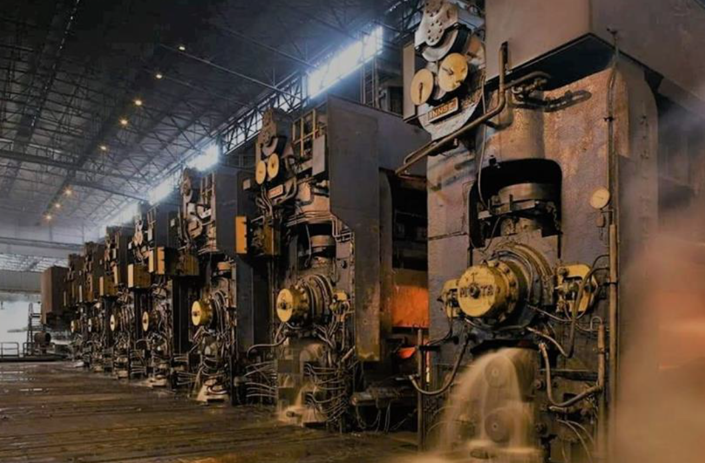
Work rolls are critical components in the hot rolling process of steel. They are continuously exposed to severe wear and cyclic thermo-mechanical loads caused by contact with high-temperature steel sheets. After each rolling campaign, the damaged roll surface must be reprofiled. This process is repeated until a minimum diameter is reached, at which point the roll can no longer be machined and must be discarded.
The RENEWable Hot Rolling ROLLs through DED-LB/P Technology – RenewRolls project aims to overcome this limitation by developing repairable rolls for hot rolling finishing stands. The objective is to extend service life, reduce downtime and improve sustainability.
For that purpose a strategy combining the development of new materials (substrate + coating) and laser Direct Energy Deposition (DED-LB/P) technologies will be applied.

Related contents
General Scope
In hot rolling mills, work rolls are subjected to extreme thermomechanical loads that cause mechanical wear (surface diameter reduction and shell damage) and thermal wear (thermal crown formation). Conventional rolls require frequent replacement or refurbishment, leading to high operational costs, reduced productivity and material waste. Downtime associated with roll replacement significantly impacts steel plant efficiency and profitability. There is therefore a need for new materials and processes that extend roll lifespan, reduce operational costs and maintain mechanical integrity, while supporting decarbonization targets aligned with the EU Green Deal.
Traditionally, work rolls used in flat product hot rolling are manufactured in two ways: as bimetallic components (manufactured by centrifugal casting combining a steel or cast iron core with a high-Cr alloy outer shell), or as monolithic rolls, made of high-speed steel (HSS), which provide the high wear resistance required under demanding service conditions. HSS rolls, however, rely heavily on critical raw materials such as tungsten, cobalt and vanadium. The solutions based on HiCr alloys on their side reduce dependence on some of these materials, but still suffer significant wear under thermal cycling and repeated contact with hot steel.
The wear of a single roll often requires the re-profiling of multiple rolls within the same rolling mill to maintain dimensional consistency, generating extended downtime and high maintenance costs. Once the minimum diameter is reached, rolls are discarded, increasing cost, waste and environmental impact.
Laser-based Directed Energy Deposition of powdered materials (DED-LB/P) offers an additive manufacturing solution to extend roll life and restore worn rolls while reducing CRM consumption. The technology provides focused energy input, minimal heat-affected zones and precise control of material deposition. Powder composition can be tailored to optimize hardness and wear resistance for specific rolling conditions. Multiple refurbishment cycles become possible, supporting lifecycle management and circular economy principles. However, applying DED-LB/P coatings on cast iron substrates presents challenges due to microstructural heterogeneity, thermal conductivity and crack susceptibility. Overcoming these barriers would enable substitution of conventional HSS rolls with repairable solution.
Objective
The main objective of RenewRolls is to develop a more sustainable alternative to conventional hot rolling work rolls based on cast iron cores and HSS shells. The project will develop repairable cast iron rolls featuring high-performance HSS coatings applied through DED-LB/P processes, including Laser Cladding (LC) and Extreme High-Speed Laser Application (EHLA).
This switch will enable:
- Reduced dependence on critical raw materials (CRMs)
- Extended service life through multiple refurbishment cycles
- Lower operational costs and material waste
- Improved dimensional consistency and reduced downtime
- Contribution to the European Green Deal and circular economy principles
Specific objectives
Must compensate dilution and improve coating integrity through flux additions. Ferritic cast iron substrates with improved weldability characteristics for defect-free deposition of DED-LB/P coatings.
Coating layers applied via LC and EHLA on cast iron substrates using project-designed HSSs and commercial alloys blended in situ.
DED-LB/P customised coatings on cast iron substrates suitable for hot rolling work rolls, ready for pilot-scale validation in industrial conditions.
Repeatable and precise DED-LB/P coatings for rolls must be achieved.
Coated rolls meeting industrial requirements must be assured.
Demonstration of multiple refurbishment cycles of worn rolls using DED-LB/P, restoring original dimensions and surface quality while maintaining performance and reducing waste and reliance on CRMs.
Approach
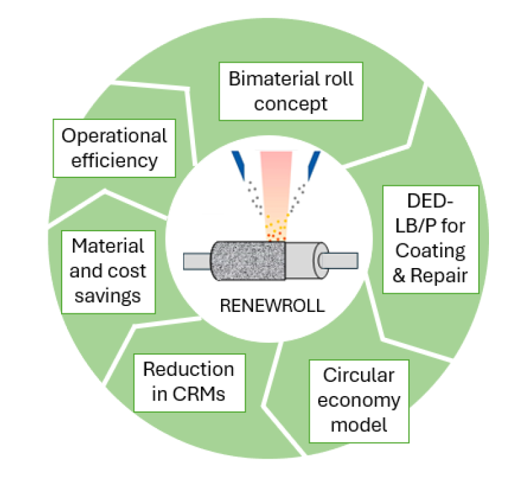
The main innovation proposed by RenewRolls consortium lies in the application of 1–2 mm thick ultra-hard high-speed steel (ASP family) coatings through laser Direct Energy Deposition (DED-LB/P) on nodular cast iron rolls that are traditionally difficult to weld.
With that aim the project addresses:
- Optimized material composition design for coatings and cast substrates
- Process monitoring and control strategies
- Wear simulations and predictive modelling
- Tailored post-processing strategies
Advanced Additive Manufacturing
Laser Cladding (LC) and Extreme High-Speed Laser Application (EHLA) are used to deposit ultra-hard coatings with controlled microstructure, minimal dilution and tailored composition.
Optimized Materials
- Tailored cast iron substrates with enhanced weldability.
- Customized HSS powder alloys to reduce CRM use while maintaining performance.
Robust Process Control
Real-time monitoring (pyrometry, IR imaging) and adaptive control algorithms ensure deposition repeatability and geometric precision.
Lifecycle Management
Post-deposition heat treatments and precision grinding enable refurbished rolls to meet industrial requirements for hardness, roughness and wear resistance.
Expected results & Impact
RenewRolls will deliver:
- Proven methodologies for thermal and wear modelling of work rolls
- New cast iron alloys optimized for DED-LB/P compatibility
- Customized metallic powders with reduced CRM content
- Reliable monitoring and control systems for industrial roll processing
- Design and validation of repairable hot rolling work rolls
- Demonstrators of new and refurbished rolls produced via LC and EHLA
- Validated refurbishment protocols ready for pilot-scale implementation
Economic and operational benefits
Operational costs will be reduced by enabling:
- Fewer roll replacements
- Shorter downtime and improved productivity
- Lower inventory of spare parts and faster on-demand repairs
- A shift from costly consumables to sustainable capital assets
Industrial Impact
The project strengthens European capabilities in additive repair technologies, supports SME integration, and fosters new service-oriented business models in equipment lifecycle management.
Environmental & Societal Benefits
Compared to producing new rolls (15–17 t cast steel, ~5.8–10.4 MWh and ~6.6–10.4 tCO₂ per roll), refurbishment significantly reduces:
- Energy consumption
- CO₂ emissions
- Demand for virgin raw materials
Scientific Impact
- Powder metallurgy and tailored alloys
- Compatibility of cast metallurgy with additive deposition
- In-situ process monitoring and adaptive control science
- Digital models for process simulation and optimization
Project consortium

Tekniker
(Spain)
Project leader

AZTERLAN Metallurgy Research Centre
(Spain)

Rina Consulting
(Italy)

Acciaierie d'Italia
(Italy)
News and dissemination
News
Divulgation
-no content to show-
Scientific publications
-no content to show-
Video
-no content to show-
Other publications
-no content to show-
Other technical data
- Call: RFCS-2025
- Total funding: 1,600,138.758€
- EU’s contribution: 960,083.25€
- Duration: 42 months (2026/06 – 2029/12)
Funding

This project has received funding from the European Union’s Research Fund for Coal and Steel (RFCS) under grant agreement No. 101296123.
Views and opinions expressed are however those of the author(s) only and do not necessarily reflect those of the European Union or CINEA. Neither the European Union nor the granting authority can be held responsible for them.