

The European LIFE GREENCASTING project was completed in April 2026 after almost four years of research, delivering significant advances in inorganic binder systems and robust environmental data, while strengthening collaboration with foundries across Europe.
Objectives and approach
The project focused on the development and implementation of inorganic binders based on alkaline silicates and geopolymers in six ferrous foundries located in Spain, Poland, Estonia, Finland and Italy.
Its main objectives were to:
- Reduce hazardous emissions generated during moulding, pouring and shakeout operations, thereby improving workplace air quality.
- Demonstrate the technical and operational feasibility of inorganic binder systems to ensure the stable production of high-quality iron castings.
- Promote the reuse of foundry sand through regeneration processes and its subsequent reuse or external valorisation.
Emissions assessment
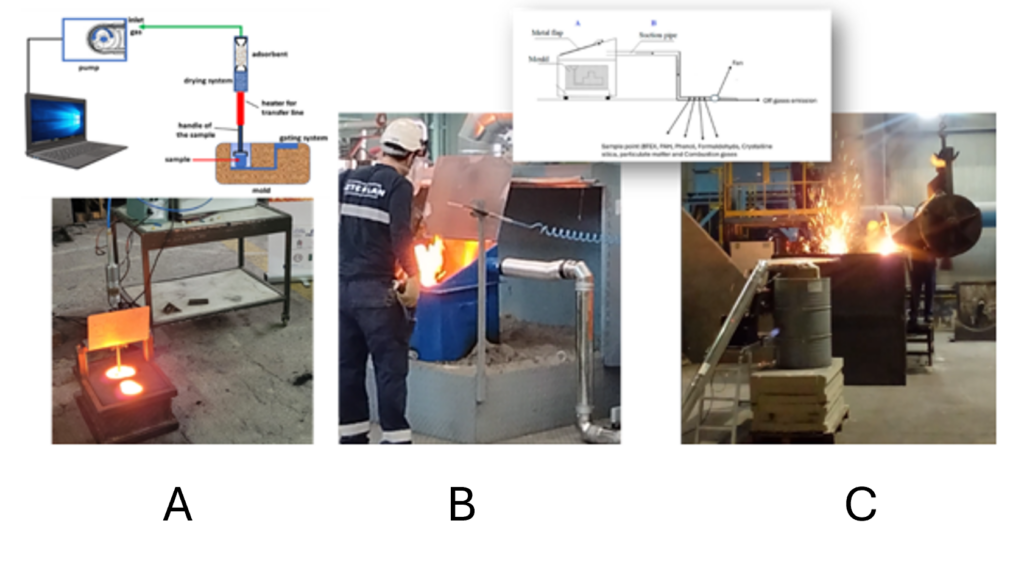
Emissions were evaluated at laboratory, pilot and industrial scale, comparing conventional organic binder systems (furan, phenolic urethane and alkaline phenolic), green sand moulding with bentonite, and silicate-based inorganic binders supplied by SANDTEAM (Peak Deutschland GmbH).
More than 25 experimental trials were carried out in a closed testing chamber, where the mould was placed and emissions generated after pouring molten iron were continuously monitored. This approach enabled a direct comparison of the different moulding systems under equivalent conditions.
The inorganic binder systems showed significant reductions in emissions:
- BTEX (benzene, toluene, ethylbenzene and xylenes): more than 93% lower than conventional organic binders and 65–71% lower than green sand.
- PAHs (polycyclic aromatic hydrocarbons): more than 94% lower than organic binders and more than 90% lower than green sand.
- Lower peak emissions of CO, NOₓ and SO₂.
These results have been published in three peer-reviewed scientific papers, providing a detailed description of the methodology and findings at different scales:
- Laboratory scale – AGH University: International Journal of Molecular Sciences, 25, 5496. DOI: 10.3390/ijms25105496.
- Pilot foundry scale – AZTERLAN: Molecules, 30, 2765. DOI: 10.3390/molecules30132765.
- Industrial scale – Odlewnie Polskie S.A. (Poland): Process Safety and Environmental Protection, 2025, 108238. DOI: 10.1016/j.psep.2025.108238.
Authors:
David Valle (Metalúrgica Madrileña, S.A.), Erika Garitaonandia (AZTERLAN), Andoni Ibarra (AZTERLAN), Javier Abello (Metalúrgica Madrileña, S.A.), Ramón Domínguez (Metalúrgica Madrileña, S.A.)
Keywords:
cast iron, foundry, binders, inorganic binders, organic binders, green molding, foundry sand, foundry cores.
Related contents:
Life Cycle Assessment
A Life Cycle Assessment (LCA) was carried out to compare the environmental performance of five binder systems: three organic binders (furan, phenolic urethane and alkaline phenolic) and two inorganic alternatives (sodium silicate and geopolymers).
The results demonstrated that inorganic binder systems consistently achieved lower environmental impacts across most of the evaluated categories.
In particular:
- Geopolymer-based binders showed improvements in all 12 impact categories considered in the study.
- Modified sodium silicate binders achieved lower impacts in 10 out of the 12 categories.
The most significant reductions were observed in:
- Aquatic ecotoxicity: more than 90% reduction
- Human toxicity: more than 97% reduction
- Photochemical ozone formation: more than 70% reduction
- Global warming potential (CO₂ equivalent): more than 55% reduction
These results confirm that inorganic binder technologies not only reduce emissions inside the foundry but also offer substantial environmental benefits throughout the life cycle of the binder system.
Industrial implementation
Silicate-based inorganic binders are attracting increasing interest due to their environmental and occupational health benefits. However, their implementation in iron and steel foundries remains a technically demanding process.
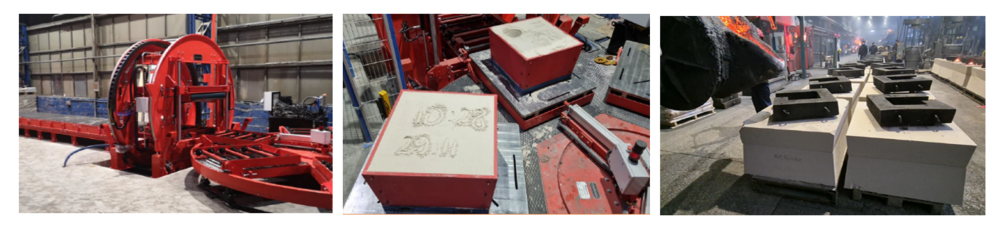
Moulding trials and industrial implementation carried out within the project showed that each foundry required specific adaptations depending on factors such as: mould and core design, alloy type, manual or automatic moulding equipment, and ambient operating conditions.
These adaptations included reformulating binder compositions and optimising binder dosage to achieve the right balance between initial strength and residual strength after pouring and cooling.
One of the main technical challenges was the collapsibility of complex cores, which was successfully improved through the use of tailored additives and process optimisation.
The transition also required investment in—or adaptation of—existing equipment, including sand mixers, thermal control systems, automatic moulding lines and core shooters. The extent of these modifications depended largely on each foundry’s level of automation.
For this reason, implementation was carried out progressively through pilot trials.
The experience gained during LIFE GREENCASTING demonstrates that the adoption of inorganic binders should be considered a structured transition process rather than a simple material substitution.
Key technical aspects
The LIFE GREENCASTING project has identified several critical aspects that should be considered when designing and implementing inorganic binder systems in ferrous foundries.
1. Sand–binder interactions
Both silica and non-silica sands, together with their physical characteristics—such as grain morphology (rounded or angular) and grain size distribution (fine or coarse)—have a significant influence on the performance of alkaline silicate-based inorganic binder systems.
These interactions directly affect key mould and core properties, including: Flexural strength, Permeability, Thermal stability.
Selecting the appropriate sand–binder combination is therefore essential to ensure that moulds and cores meet the required quality and performance specifications.
Curing methods and curing kinetics
Binder chemistry plays a fundamental role in determining the curing mechanism.
For inorganic binder systems, hardening may occur through two different routes:
- Physical curing (reversible dehydration): Water is removed by means of hot air, warm-box or hot-box technologies, or microwave heating. As water evaporates, silicate bridges are formed, providing the mechanical strength required by the mould or core.
- Chemical curing (irreversible reaction): Hardening can also be achieved through chemical reactions with CO₂ gas or liquid esters.
The selected curing route has a major influence on: Mechanical strength, Thermal stability, Moisture resistance, Long-term storage stability.
Most innovative inorganic binder systems are based on two-component formulations, consisting of a liquid binder (typically sodium silicate or a geopolymer precursor) combined with a powdered additive.
These additives improve flowability, curing rate, core strength, storage stability and resistance to metal penetration.
3. Thermal behaviour, residual strength and sand collapsibility
Silica sand undergoes the β→α quartz transformation at approximately 573°C, producing a volumetric expansion of around 2.4%, which may lead to casting defects.
Unlike organic binders, whose bonding bridges degrade by oxidation at elevated temperatures, inorganic binders behave differently.
At high temperatures, the inorganic bonding phase may soften and become semi-liquid, allowing limited deformation without fracture. However, at temperatures around 800°C, a second strength peak appears due to the formation of a vitreous SiO₂–Na₂O phase.
This phenomenon increases the compactness of the moulding material, making core collapsibility and core removal more difficult.
Recent developments in chemically modified inorganic binders, together with specially designed additives, have significantly reduced this residual strength, greatly improving collapsibility, even for complex cores completely surrounded by molten metal.
4. Moisture sensitivity
When curing takes place by dehydration, the process remains partially reversible.
As a consequence, cores stored under high-humidity conditions may absorb moisture, leading to strength loss and degradation of their structural integrity.
To avoid these problems, foundries should:
- Control relative humidity during storage.
- Minimise storage times.
- Validate core shelf life under real production conditions.
Operational and economic aspects
The implementation of inorganic binder systems requires investment, the extent of which depends on each foundry’s existing level of automation and the selected curing technology (self-setting, hot-box or warm-box processes, or CO₂ gas curing).
Typical areas requiring adaptation include:
- Sand mixing equipment
- Sand reclamation systems
- Automatic moulding lines
- Core shooters
- Storage facilities capable of maintaining appropriate humidity conditions
However, the transition to inorganic binders can also generate significant economic benefits.
Among the most relevant are:
- Elimination of amine scrubbing systems and their associated operating and maintenance costs.
- Reduced expenditure related to health, safety and environmental compliance.
- Lower rejection rates caused by gas-related casting defects, thanks to the reduced gas generation of inorganic binder systems.
- Improved process yield and overall profitability.
Although the initial investment may be significant, the long-term environmental, operational and economic benefits can outweigh these costs when implementation is properly planned and adapted to the specific characteristics of each foundry.
Sand reclamation
The project successfully validated both hydrometallurgical reclamation at laboratory scale and primary and secondary mechanical reclamation at industrial scale for inorganic binder systems.
Both approaches proved effective in reducing the key parameters associated with spent inorganic moulding sands, including:
- Electrical conductivity
- Na₂O content
- Fine particle content
Sand mixtures containing 85–100% reclaimed sand achieved flexural strengths between 1.6 and 2.2 MPa, representing excellent performance for self-setting inorganic binder systems.
Mechanical properties remained stable after repeated reclamation cycles, demonstrating that reclaimed sand can be successfully reused with only minor adjustments to binder dosage.
These results confirm that inorganic binder technologies are compatible with circular sand management strategies, contributing to lower raw material consumption and reduced waste generation.
Conclusions
The LIFE GREENCASTING project has demonstrated that inorganic binder systems can significantly reduce hazardous emissions while improving environmental and occupational conditions in iron foundries.
At the same time, successful implementation requires careful control of several critical process parameters, particularly:
- Curing conditions.
- Core collapsibility after casting.
- Sand reclamation efficiency.
- Moisture management.
- Process adaptation to the specific characteristics of each foundry.
Industrial experience clearly shows that adopting inorganic binders is not simply a matter of replacing one material with another.
Instead, it should be approached as a comprehensive process redesign that must be validated through pilot trials and gradual implementation, taking into account each foundry’s products, equipment