
After nearly four years of work, the European project GREENCASTING LIFE has come to an end, delivering a clear message: the transition towards inorganic binder systems in iron casting “is technically feasible and can yield favorable results, provided that its implementation is based on a thorough analysis and adaptation to the specific characteristics of each process.”
GREENCASTING has brought together technology centers, universities, and foundries from different European countries with a common goal: to reduce emissions associated with molding, pouring, and shakeout, while improving air quality in plants and the sustainability of the process.
AZTERLAN researcher Erika Garitaonandia, project coordinator at AZTERLAN, reviews the main achievements and lessons learned from GREENCASTING.
Significant emission reduction
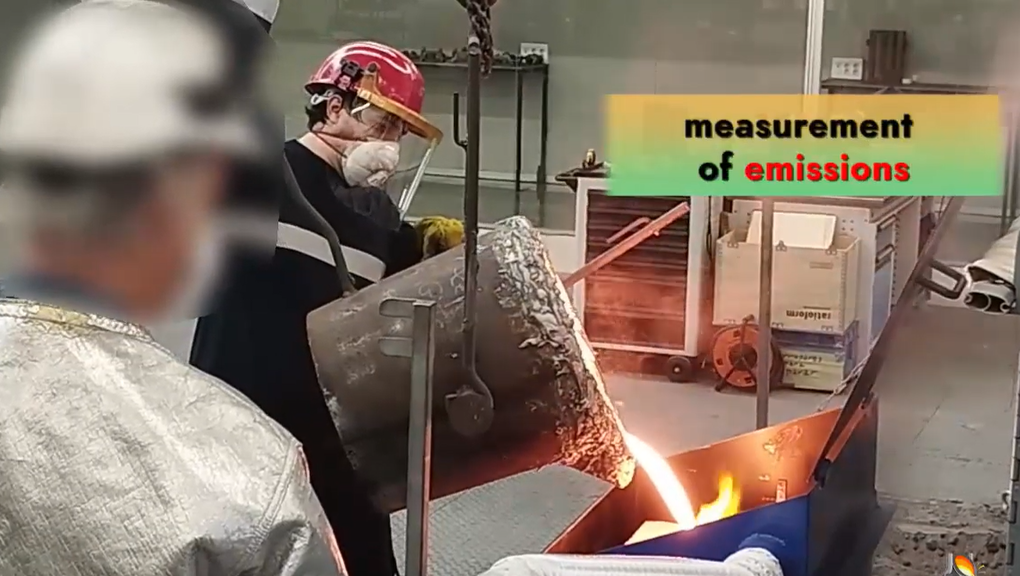
One of the most consistent outcomes of the project has been the reduction of pollutant emissions associated with inorganic systems compared to conventional organic ones.
Tests carried out at laboratory scale, pilot plants, and full industrial production environments have shown reductions of over 90% in BTEX and PAH compounds, along with lower peaks of gases such as CO, NOx, and SO₂. “Emission reduction has been demonstrated across all environments, including real industrial conditions.”
No universal solution
Despite the environmental benefits, the project has shown that industrial implementation of these systems is not straightforward, and there is no single solution for all cases.
“Each foundry has specific conditions in terms of sands, alloys, molding systems, and automation levels, which requires adapting formulations and processes. For this reason, each foundry must adjust the system to its productive reality.”
The challenge: improving shakeout and increasing core collapsibility
One of the main technical challenges identified has been core collapsibility, “especially in systems based on sodium silicates, where a secondary strength at high temperature may appear, making shakeout more difficult.”
Work carried out within the project has enabled improvements through new formulations and specific additives, with positive results even in complex geometries. “This has allowed us to make clear progress in one of the system’s most critical aspects: shakeout capability.”
Sand regeneration: key to viability
Another cornerstone of the project has been sand regeneration, a key element for the economic and environmental sustainability of the system. “Without sand regeneration, the sustainability of the system is incomplete; it is an essential part of the process.”
The results show that it is possible to reuse high percentages of reclaimed sand while maintaining adequate mechanical properties, opening the door to more circular models in foundry processes.
Progressive implementation rather than direct substitution
The project’s industrial experience has shown that transitioning to inorganic systems requires investment, process adjustments, and progressive validation in the plant. Therefore, “rather than direct substitution, the approach must be evolutionary. This is not about replacing one product with another, but about transforming how the molding process is designed and controlled.”
Conclusion: a working technology to be introduced progressively
Based on the results, the GREENCASTING LIFE consortium considers the overall balance positive: inorganic systems have demonstrated strong potential to significantly reduce emissions without compromising mold properties, but their implementation requires technical knowledge and industrial support.
“The technology works, but the key does not lie in direct material substitution; instead, it lies in progressive integration based on deep process knowledge and adaptation to the specific characteristics of each plant.”
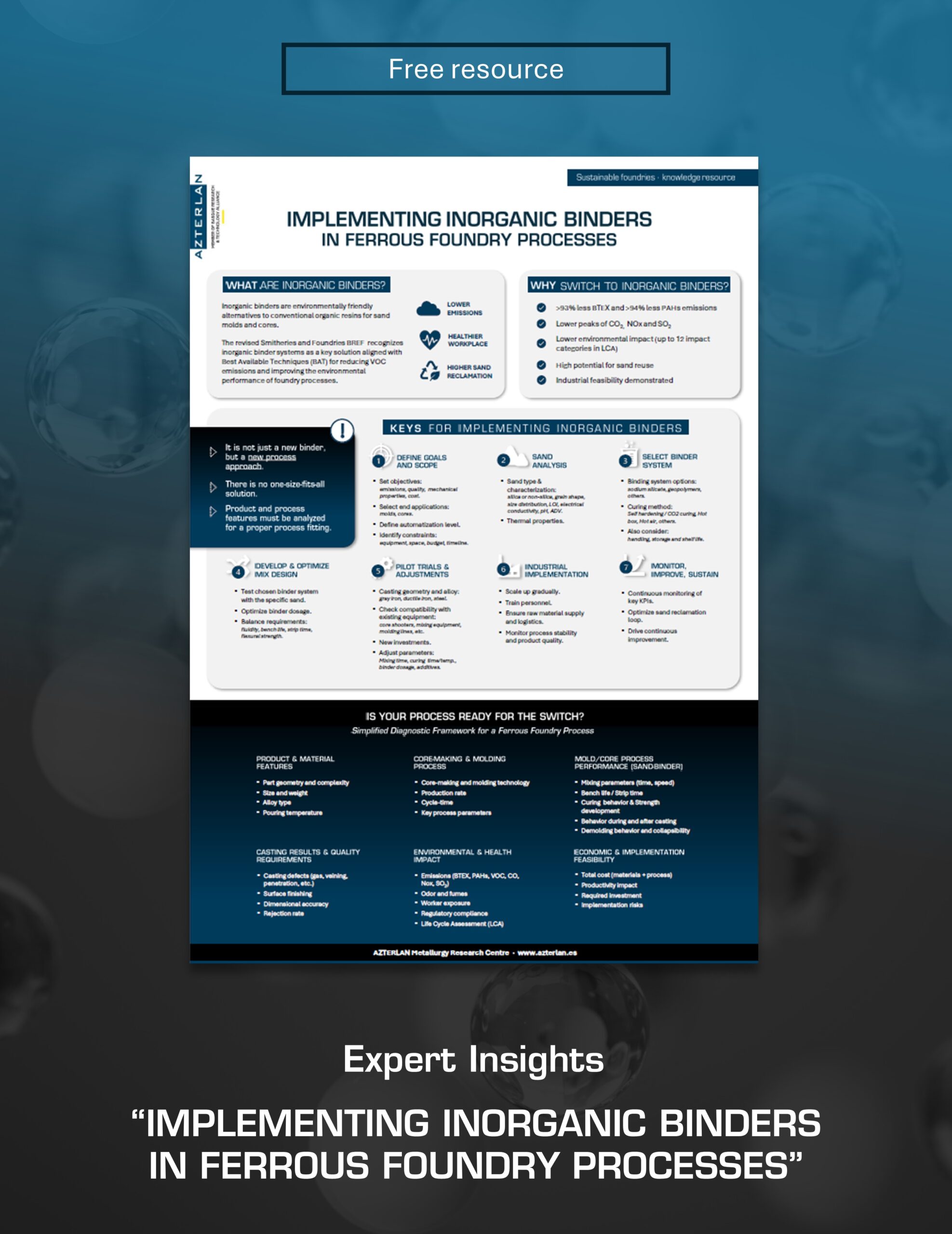
Downloadable resource: “Short guide to implementing inorganic binders in ferrous foundry processes”.
The GREENCASTING LIFE project has been co-funded by the European Union’s LIFE program under grant agreement LIFE21-ENV-FI-101074439. Now concluded, it leaves behind scientific results, industrial validation, and a European collaboration network that will continue to drive progress towards more sustainable foundry processes.