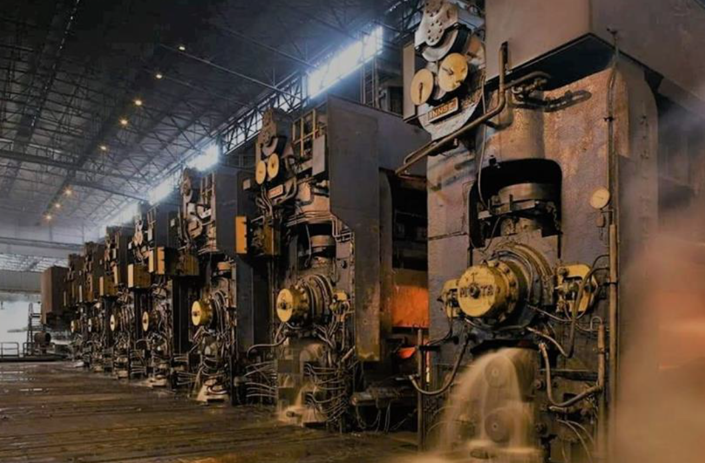

The 8th Technical Forum on Heat Treatment, TRATER DAY 2025, has brought together topics of high relevance for the heat treatment sector, such as the opportunities offered by simulation tools and their evolution, technical aspects regarding the development of heat treatment furnaces and the impact of the incorporation of new fuels on the decarbonization and efficiency of the sector, along practical applications of heat measurement tools. The speakers also shared practical cases aimed at solving issues related to the conception and manufacturing of new products and designs.
In line with the challenges and growing requirements of the manufacturing and user industries of metal components, the heat treatment sector faces the challenge of proposing and incorporating innovative and efficient solutions that improve the characteristics and durability of materials and products aimed at highly demanding sectors such as aeronautics, shipmaking or automotive sectors.
With the aim of sharing some of the leading innovations for the sector and relevant knowledge regarding the evolution and challenges of heat treatments, the TABIRA FOUNDRY INSTITUTE, the AZTERLAN Metallurgy Research Centre and TRATER PRESS, with the collaboration of EUSKALIT and DEK Durangaldea Ekimena, held the 8th Technical Forum on Heat Treatment, TRATER DAY 2025. The agenda for the day had a markedly technical nature and the conference was structured around presentations by representatives of companies and organizations of reference for the sector in our industrial environment:
- Igor Pérez. Keysight’s Solution Engineer: “Simulation of the heat treatment of cast aluminum parts: dimensional prediction and residual stresses in structural parts”.
- Jorge Almeida. Senior Sales Engineer at INSERTEC Furnaces and Refractories: “Decarbonization and electrification in aluminum foundry. Alternatives to natural gas”.
- Dr. Arron Rimmer. Director of ADI TREATMENTS LTD. “From eleven-element subassemblies to a single part: an example of the advantageous combination of casting and heat treatment”.
- Eugenio Pardo. Application Engineer at ONDARLAN, S.L.-INDUCTOTHERM GROUP IBERIA: “Discovering the secrets of the design theory of induction coils”.
- Rubén Díaz. Application Engineer at MESUREX Instrumentation and Control: “Thermographics applied to heat treatment: fundamentals, innovations and applications”.
- Dr. Jon Arruabarrena. Researcher in the Forming and Heat Treatment Area of AZTERLAN: “Thermodynamic calculations for the definition of heat treatments: use cases”.
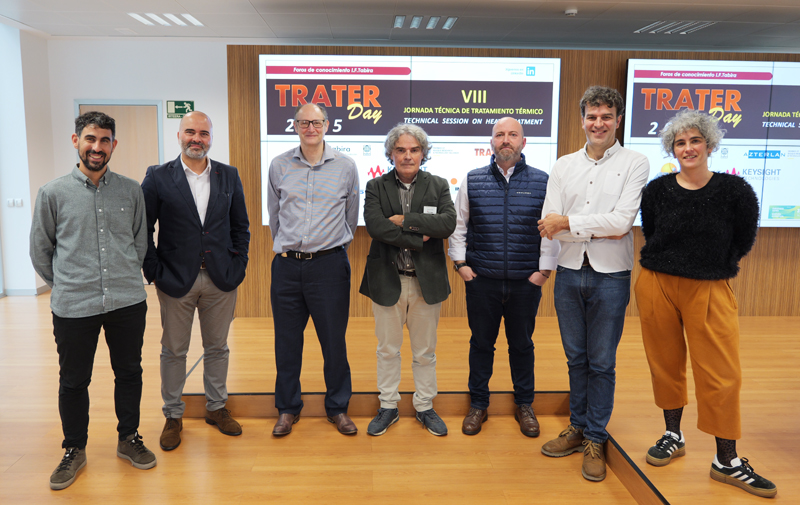
Speakers of TRATER DAY 2025: Igor Pérez (KEYSIGHT), Jorge Almeida (INSERTEC), Arron Rimmer (ADI TREATMENTS), Eugenio Pardo (ONDARLAN), Raúl Díaz (MESUREX), Jon Arruabarrena (AZTERLAN); and chairwoman: Itziar Berriozabalgoitia (AZTERLAN)
The first presenter of the day was Igor Pérez, simulation software specialist from KEYSIGHT, who shared a presentation focused on the simulation of aluminum parts. Pérez opened his speech by stating that heat treating alluminum castings induces stress redistribution and deformation phenomena associated with thermal gradients and microstructural relaxation. “During solubilization, part of the residual stress accumulated in the casting process is released, while the quenching stage (characterized by high thermal gradients) is the one that generates the greatest geometric distortion due to localized plastic deformation. Understanding the interaction between temperature, elastic modulus and precipitation kinetics is essential to predict the final behavior.”
The simulation expert said that the complete virtualization of the metallurgical process (from foundry to heat treatment) allows thermo-mechanical mechanisms to be modeled more faithfully and that “simulating not only cooling but also thermal transfer depending on the direction and speed of hardening makes it easier to anticipate the tension and thermal evolution in the real part.” He shared that the key variables are: the relative orientation of the part against the thermal flow, the cooling medium and the previous thermal history inherited from the casting (initial microstructural state). “The result is a more robust prediction of internal distortions and stresses before manufacturing.”
In the same way, he presented to the audience that the systematic application of virtual metrology allows these models to be validated and adjusted through correlation between nominal geometry (CAD), real scanned part and FEM simulation. This makes it possible to evaluate dimensional conformity and quantify the deviation attributable both to thermo-mechanical phenomena and to tooling effects or real process condition. This approach is aligned with the transition to concurrent manufacturing engineering.
Pérez concluded his participation by assuring that the combination of the fusion between advanced modeling and metrological validation reduces process uncertainty and allows optimizing heat treatment parameters in a targeted way. “The goal is not only to correct deviations, but to design the process to avoid them: more stable geometries, controlled internal stresses and reproducible mechanical behavior, particularly relevant in critical structural components and Gigacasting scenarios.”
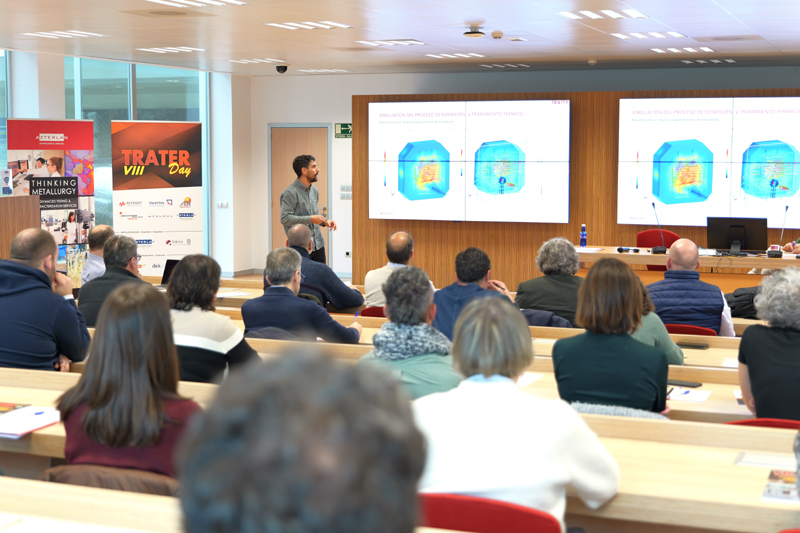
Igor Pérez (KEYSIGHT) during his presentation at TRATER DAY 2025
Arron Rimmer, Austempered Ductile Iron expert from ADI TREATMENTS, presented a case study of the development of a new part design for a Unimog vehicle (small truck) that replaces a sub-assembly of eleven parts. “The application of autempered ductile cast iron (ADI) has made it possible to replace a welded structure of multiple steel components with a monolithic casting.” Rimmer shared that the success of the new component lies in the change in geometric design and in the mechanical properties inherent to the ausferritic microstructure obtained by austempering, “which translates into a significant increase in the safety factor against eccentric and torsional loads that previously caused deformations and failures in the versions made of welded steel parts”.
Rimmer shared that, from a microstructural point of view, the selected ADI 900-8 offers an optimized balance between strength and toughness thanks to the controlled isothermal transformation of austenite to ausferrite, providing high values of strength and deformation capacity. “The austempering process is carried out after casting, with precise thermal control and through the use of cast tie bars that stabilize the geometry during treatment, ensuring structural homogeneity through considerable thicknesses in the final part without degradation of mechanical properties in the core with respect to the periphery.”
The ADI expert stated that the simulation and stress analysis show that the hot spots, the critical stress concentration points, that appeared in the original welded design are significantly lower in the ADI part, translating into drastic reductions of equivalent Von Mises stresses under load, and in a more predictable behavior against complex stresses generated by misalignments or lateral loads during real operation. “This structural benefit is linked to both the optimized cast geometry and the elasto-plastic response of the tempered material.”
Rimmer also shared that the transformation of the production process, from welded manufacturing to cast and heat-treated design, has also made it possible to simplify the industrial production chain by reducing assembly operations, adjusting final tolerances through focused machining and improving dimensional repeatability. In conclusion, he stated that “microstructural control through heat treatment can serve as a structural design and functional optimization tool in demanding industrial applications.”
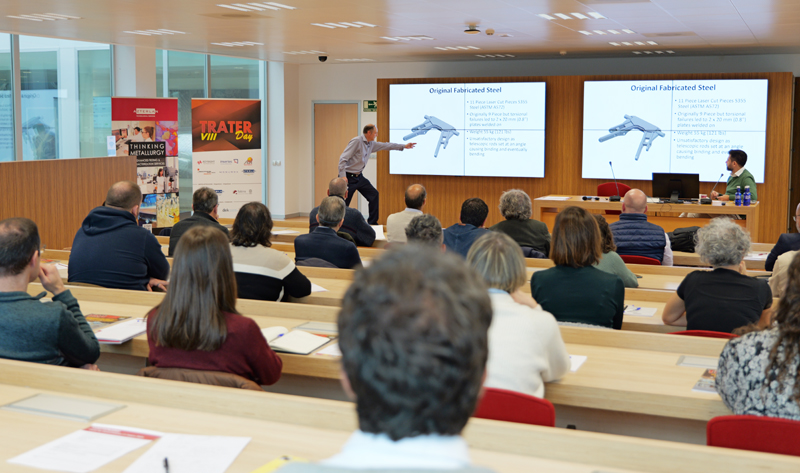
Dr. Arron Rimmer (ADI Treatments) at TRATER DAY 2025
Jorge Almeida, representative of INSERTEC Furnaces and Refractories, focused his participation on the need to understand the characteristics and effects on production of the real alternatives that exist to natural gas in the context of industrial decarbonization and how electrification “although useful, is not a universal solution”. In his words, decarbonization should not only be analyzed from an energy and economic point of view, but also from the direct impact that fuels and combustion modes generate on thermal processes and on the final quality of heat-treated components.
According to the industrial-furnaces-expert, biomethane is currently the most immediate and compatible option to substitute natural gas: its composition and calorific value are very similar to natural gas, so it can be used in existing furnaces without altering the flame temperature, cycle times or treatment atmosphere, avoiding alterations in the microstructure and mechanical properties of the treated materials. “This is crucial for processes such as quenching, tempering, normalizing, melting or thermal maintenance, where temperature homogeneity and atmospheric control are decisive.” In addition, he shared that, having a calorific value similar to natural gas, heat transfer rates and cycle times are not affected, maintaining constant productivitys and avoiding furnace redesigns. The reduction in CO₂ associated with biomethane (between 70-80% compared to natural gas) also allows it to operate with a lower environmental footprint without sacrificing thermal stability or metallurgical quality.
Almeida also analyzed the use of hydrogen as a fuel, stating that it introduces relevant technical challenges. “Hydrogen combustion produces hotter flames and large amounts of water vapor, which affects refractories and can generate unwanted oxidation of the parts. In addition, its high temperature favors the formation of NOx. Also, the impossibility of seeing the flame in infrared complicates the control of the process.” He stated that, as a consequence, using hydrogen in heat treatments requires redesigning burners, control systems and internal atmospheres, to avoid altering the microstructure or surface finish of the materials. Therefore, “while biomethane allows a rapid and stable transition, hydrogen is a promising option, but one that still requires technological adaptation to ensure that the performance and integrity of the parts is not compromised.”
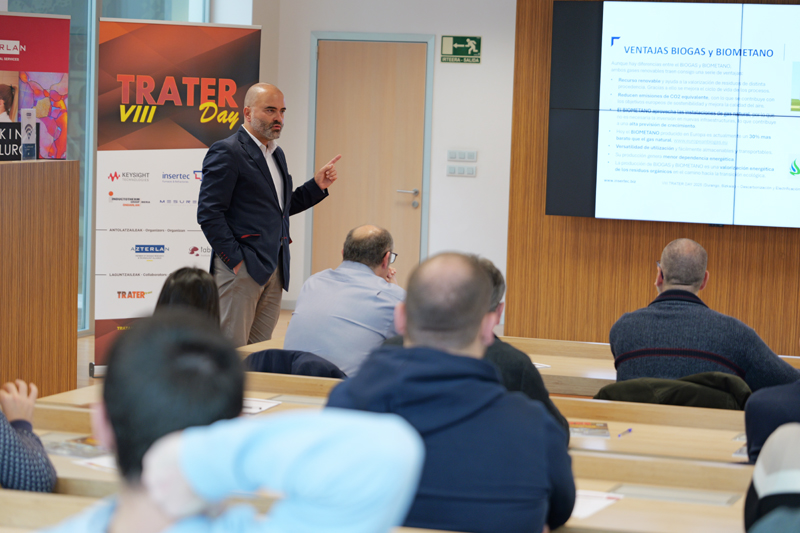
Jorge Almeida (INSERTEC) at TRATER DAY 2025
The expert from ONDARLAN, S.L. Inductoterm Iberia, Eugenio Pardo, focused his presentation on the different induction systems and their characteristics, stating that induction hardening lays on a deep knowledge and application of electromagnetic engineering: frequency selection, material knowledge, part geometry and simulation. Thanks to this, “in expert hands, induction becomes an extremely precise tool to obtain surface hardness profiles with micrometric control and repetitive stability”, which makes it play an important role in heat treatments of critical components.
In his words, “the great advantage of induction is the superficial nature of the heating: the energy is first deposited on the periphery of the part, obtaining externally hardened layers while the core maintains tenacity.” In addition, the entire process is carried out quickly (hundreds of degrees per second), which allows for high-productivity industrial heat treatments.
Pardo shared with the audience the characteristics of different types of induction furnaces, the coil design process and the selection of the frequency, “key to determining the heating depth.”
As a final point of his presentation, the Ondarlan expert also showed how different materials respond differently to induction by offering real examples of finite element simulation, where spacing between turns and magnetic field distribution were optimized to eliminate temperature differences of up to 200°C on the surface.
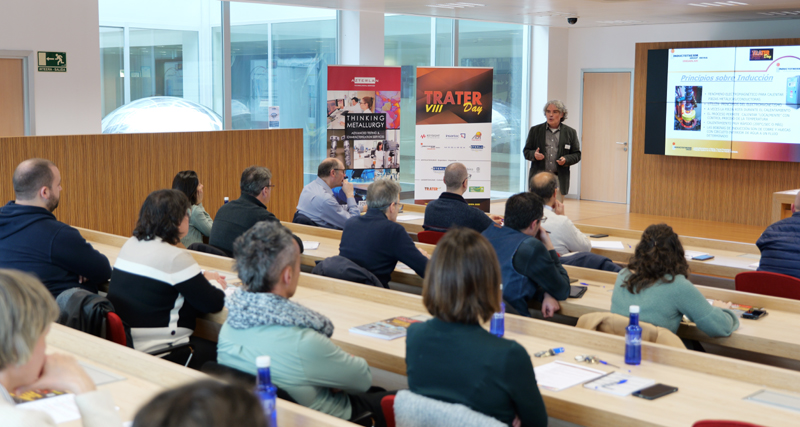
Eugenio Pardo (Ondarlan) presenting at TRATER DAY 2025
Rubén Díaz, from MESUREX, a company dedicated to non-contact temperature measurement using pyrometers and thermographic cameras for industrial applications, began his speech by sharing that “remote measurement makes it possible to avoid contact with sensitive or very hot surfaces, increase operator safety and measure multiple points and surfaces in real time”. According to him, the core of this technology is the infrared radiation emitted by bodies, and it is key to choose the appropriate wavelength depending on the material.
The temperature measurement expert stressed that one of the main challenges is emissivity, that is, the ability of a material to radiate temperature. “In practice, we almost never measure ‘ideal’ bodies, but real materials with varying and often unknown emissivities.” As he explained, especially polished metals such as aluminum or copper reflect a lot, but radiate little, which complicates the reading of this parameter. Díaz shared some techniques that improve temperature capture, such as: the use of short wavelengths in hot metals, painting the surface, pasting high-emissivity labels or even taking advantage of (or making) cavities or holes in the part, where the effective emissivity increases significantly.
The Measurex expert also stressed that another relevant aspect is the measurement optics. “With pyrometers, a single point is measured, and it is critical that the entire spot is on the piece; On the other hand, with thermal imaging cameras we capture entire areas and can select the maximum temperature within the scene.” There are cases where it is necessary to measure through crystals: when the wavelength is short, it can pass through glass; when it is not, special crystals such as zinc selenide or silicon are used, whose transmissivity coefficient must be programmed into the equipment to correct the measurement. Even simple solutions such as thin plastic films can function as transmissive protective filters.
Díaz also explained that the integration of specific wavelengths makes it possible to isolate combustion gases or measure product without interference from the flame. Together, the correct selection of sensor type, optics, wavelength, and emissivity/transmissivity programming are critical to accurately measuring in real-world situations where materials, surfaces, and conditions vary greatly.
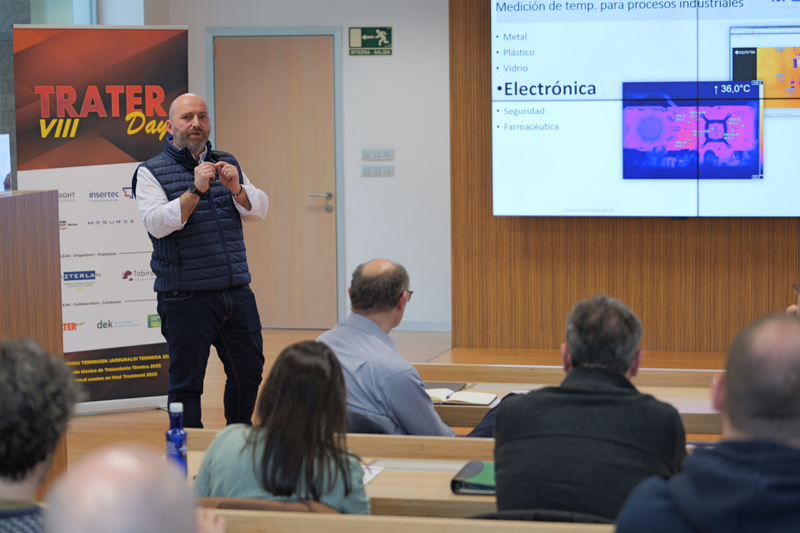
Raúl Díaz (Mesurex) at TRATER DAY 2025
The session concluded with a presentation by Jon Arruabarrena, an AZTERLAN researcher specializing in forging and heat treatment, who explained how thermodynamic simulation tools (particularly Thermo-Calc) allow for predicting the behavior of complex alloys under different temperature, composition, and heat treatment conditions. “Based on rigorous thermodynamic models and the minimization of Gibbs free energy, these tools allow us to know which phases are present, their relative stability, and how they evolve during heating, cooling, and solidification.” In Arruabarrena’s words, “this goes beyond simply performing a calculation: it’s about interpreting the material, a way of understanding the phases that constitute it and predicting their evolution with temperature or pressure without having to rely exclusively on trial-and-error experimentation.”
Arruabarrena presented real-world application examples where this type of modeling proved crucial:
- Calculating the stability of harmful phases in aluminum-killed steels to define optimal normalizing temperatures and ensure the dissolution of brittle precipitates.
- Use of calculated phase diagrams to redesign the compositions of austenitic stainless steels, promoting a fully austenitic solidification mode, resulting in more favorable solidification conditions and preventing residual ferrite at room temperature.
- Simulation of the solidification process by analyzing liquidus/solidus temperatures and predicting final segregations in white cast iron.
- Evaluation of susceptibility to hot cracking using empirical criteria applied to data derived from the thermodynamic model.
- Determination of CCT (Continuous Cooling Transformation) diagrams for hot-stamped steel grades to determine the onset times of ferrite transformation and final microstructures.
- Optimization of heat treatments through solid-phase diffusion modeling: calculating the homogenization of elements at different temperatures and times, and evaluating the time it takes for the composition gradient between the dendrite interior and the interdendritic spaces to disappear.
- Thermal cycle adjustment to maximize precipitation hardening. Obtaining mechanical properties from the characteristics of secondary precipitation.
- Identifying carbon depletion in a cladding-applied coating (in a laser weld between dissimilar materials) due to diffusion into the substrate as a function of the holding time at the peak quenching temperature.
In conclusion, the AZTERLAN expert emphasized that “this software does not replace experimental testing, but it greatly enhances the understanding of the results and facilitates the prediction of material behavior in other scenarios. In expert hands, it allows for anticipating problems, accelerating materials development, and designing heat treatments with a precision that was simply not possible before.”
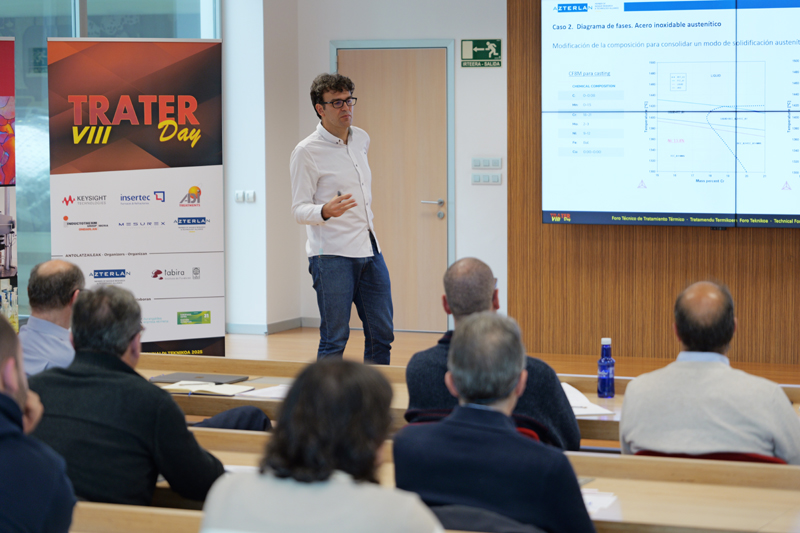
Dr. Jon Arruabarrena (AZTERLAN) at TRATER DAY 2025