Durable joints: strength and corrosion resistance in hot-stamped bimetallic fasteners

In many sectors, there is a high demand for components with specific geometries that effectively combine good mechanical properties with high corrosion resistance in aggressive environments. Fasteners exposed to marine media, automotive suspension components, and hand tools are some of these components. Thanks to additive manufacturing technologies, it is possible to produce bimetallic parts, that is, parts composed of one material in their main body, but coated with another metal. 

AZTERLAN has studied the manufacture of hybrid steel cylinders using laser deposition (DED-LB) to add a layer of AISI 316 stainless steel on a 42CrMo4 grade structural steel substrate offering good mechanical properties. This combination seeks to leverage the mechanical strength of the base steel and the corrosion protection of the coating, offering an effective solution to build high-performance components. Potential applications include fasteners targeted at offshore environments, hand tools, suspension systems, and, in general, parts subjected to both high mechanical loads and aggressive media. Hot forging or stamping manufacturing process is widely used to manufacture these types of components.

Solid state hot forming process can influence both the bimetallic bond formed using the DED-LB process and the anticorrosive properties of the coating material. Focusing on that issue, the effect of this kind hot deformation on stainless steel-faced cylinders was investigated.

The initial coating was performed using the DED-LB technique, on 42CrMo4 cylinders measuring 50 mm in diameter and 70 mm in length. A 1 mm layer of 316 stainless steel was deposited on this substrate. After this step, hot forging processes were carried out at 850 ºC and 1250 ºC also applying different degrees of deformation, simulating highly demanding industrial conditions.

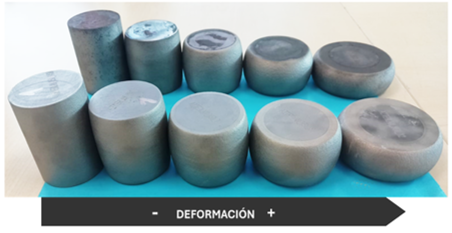
Coated cylinders subjected to varying degrees of deformation by hot stamping, with 60% being the maximum deformation.

Various heat treatments were subsequently applied to analyze the combined effect of temperature and deformation on the microstructure and corrosion behavior of the 316 stainless steel coating. First, the deformation threshold at which surface defects begin to appear was identified by means of dye-penetrant inspection. At 850°C, no significant cracks were detected up to 30% strains, while at 1250°C, the coatings remained apparently intact up to 45% strains.

The microstructural analysis of the AISI 316 stainless steel layer was performed using optical and scan electron microscopy. In the initial state (as clad, prior to forging), the coating displayed a typically dendritic microstructure, with dispersed chromium carbides and no signs of sensitization (accumulation of chromium carbides at the grain boundaries). However, the microstructures of the hot-stamped parts show a clear evolution toward sensitization, especially at high temperatures; at 850°C, marked grain boundaries are observed, although chromium carbides dispersed throughout the matrix also persist. At 1250°C, however, sensitization is complete in all samples, even in those with low deformation, indicating that temperature, rather than deformation, is the determining factor in this phenomenon.

Finally, accelerated salt-spray corrosion tests confirmed these microstructural results. The as-clad and 850°C stamped samples withstood exposure for 96 hours without oxidation, except in specific areas that showed cracks already detected by liquid penetrant inspection. In contrast, the samples stamped at 1250°C showed complete oxidation of the coating after only 24 hours, indicating a complete loss of its anticorrosive functionality.

Microstructures and images of parts subjected to salt spray testing: as-clad (left), stamped at 850°C with 45% deformation (center), and stamped at 1250°C with 45% deformation (right).

In conclusion, the results of this study demonstrate that the strategy of manufacturing bimetallic components using DED-LB laser surfacing is viable, provided the thermal conditions to which the parts are subjected during subsequent processes are carefully controlled. 316 stainless steel can maintain its anticorrosive properties even after intense deformation, provided the critical temperature threshold (between 850°C and 1250°C) that triggers sensitization is not exceeded. For industrial applications, this opens the door to the design of hybrid components that offer a good balance between mechanical strength and corrosion resistance.


Funding: This study has been performed within the ReIMAGIN project funded by the Elkartek program of the Basque Government. 

Author:

Xabier Lasheras (AZTERLAN)

Keywords:

Hybridization, Forging, LMD, Steel, Powder Metallurgy, ReIMAGIN project.

Back

How can we help you?.

Mantente informad@ de la actividad de AZTERLAN

Keep up with AZTERLAN’s activity.

Contact Gorka

Get in touch with Andoni

Contacta con Ramón

Contacta con Xabier

Contact with Maider Muro

Contact with Dr. Urko de la Torre

Contact with Dra. Anna Regordosa

Contact with Aitor Loizaga

Contact with Dr. Rodolfo González-Martínez

Contact Ander.

Contact with David Aristondo.

Contact with Juan J. Bravo.

Contact with David Garcia.

Contact with Jose Ramon.

Contact with Oihana.

Keep up with AZTERLAN’s activity.

Contact with David.

Contact with Ibon.

Contact with Hegoi.

Contact with Itziar.

Contact with Erika.

Contact with Beñat.

Contact with John.

Contact José Javier.